
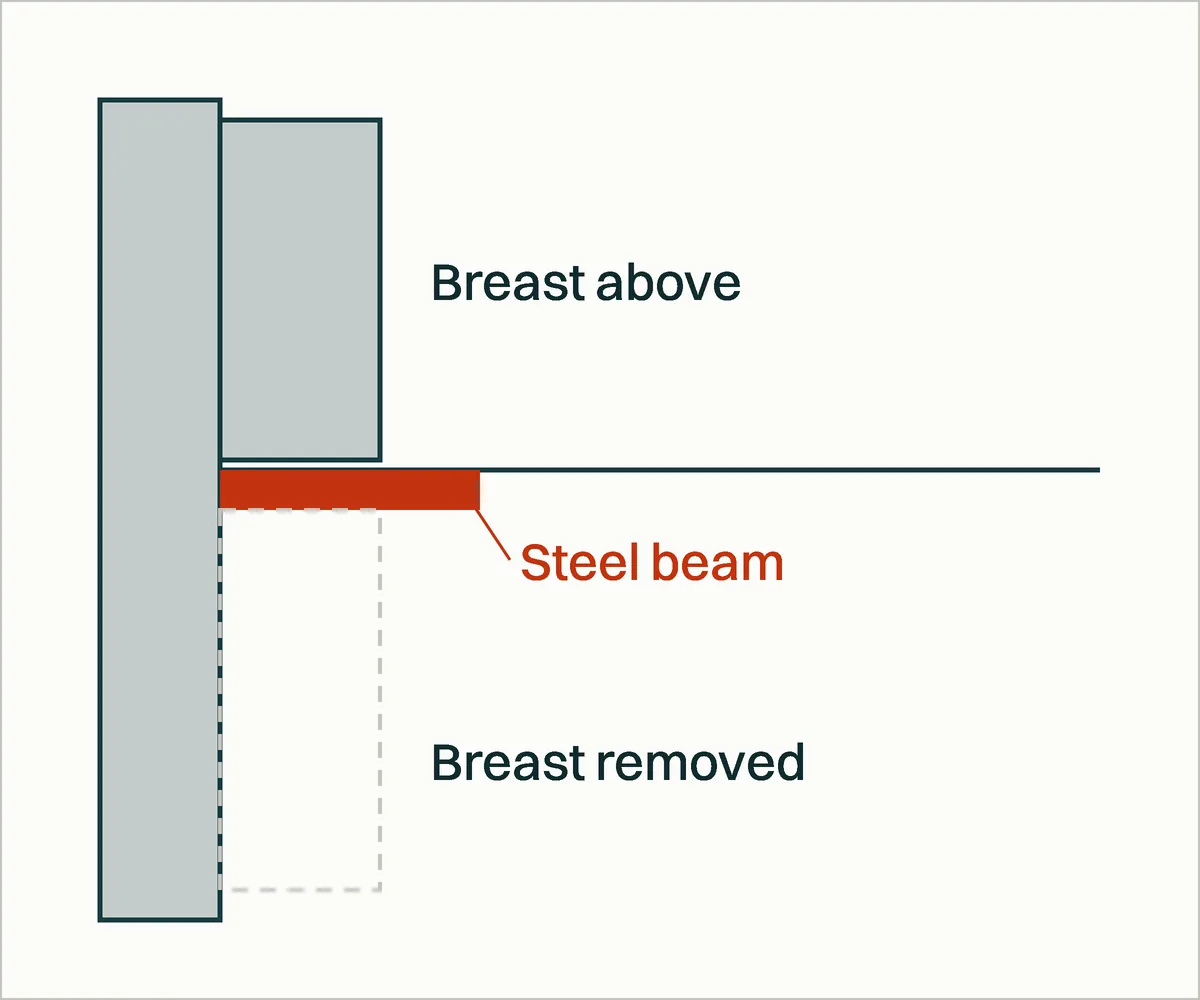
A chimney breast is the projecting part of a chimney inside the room, on every floor where there was a fireplace. It is part of the structure: it carries the chimney above it, and in many houses it stiffens the wall it sits on. Taking one out is a common way to gain floor space in a London terrace, and it is building work that needs approval and a design.
Do you need building regulations to remove a chimney breast?
Yes. LABC says "a building regulations application will be needed to remove a chimney breast", and that your structural engineer’s design will need to be submitted to building control before work starts. Its guidance suggests a full plans application rather than a building notice, "because you will need to submit calculations and have them approved before you start work". Removing only the stack above the roofline does not need building regulations approval, but removing the whole chimney throughout the house does, because the stack "may support walls, floors or the roof structure".
Do you need planning permission?
Not for an internal chimney breast in most houses. You may need other permissions if the house is listed, and in a conservation area if the stack above the roof is affected. LABC also advises checking with the planning officer before reducing a stack, because "you may need planning permission for this".
How is the chimney above supported?
Usually with a steel beam. When the breast is removed on the ground floor but stays above, the brickwork above has to be carried by something that bears on solid walls. The options and how they are viewed now:
| Support | Current position |
|---|---|
| Steel beam | Designed by an engineer, bearing on suitable walls, protected against fire. CROSS, the structural safety reporting scheme, says properly designed steel beams "can provide a verified and durable solution", and the Institution of Structural Engineers advises they should generally be used instead of gallows brackets |
| Gallows brackets | Steel brackets bolted to the wall under the remaining breast. A CROSS report says LABC "has withdrawn their technical guidance for the use of gallows brackets" since April 2024, and that historic lime mortars are often too weak to resist the forces on the fixings |
| Remove the whole chimney | Taking the breast and the stack out on every floor and the roof. Needs building regulations approval and, on a shared stack, agreement with the neighbour |
The CROSS report explains why gallows brackets have fallen out of favour in older houses: modern mortars have a strength of 4 to 12 N/mm², but historic mortars where non-hydraulic lime is the main binder are "significantly weaker", between 0.5 and 2 N/mm². Most London terraces were built with lime mortar. Your engineer decides the support; expect building control to ask for calculations whatever is proposed.
Do you need a party wall notice to remove a chimney breast?
If the breast is on a party wall, yes. The government’s Party Wall Act booklet lists cutting off projections from a party wall, "for example, removing a chimney breast", among the works that need notice, along with cutting into the wall to take the bearing of a beam. Notice must be given at least two months before the work starts. If the neighbour does nothing for 14 days after notice is served, a dispute is treated as having arisen and surveyors are appointed to agree an award.
On London terraces the chimney breasts are almost always on the party walls, back to back with the neighbour’s. If the neighbour has already removed their side, or used gallows brackets, that changes what support is possible, so the engineer needs to know.
What else has to happen when a chimney breast comes out?
- Gas, heating, plumbing and electrical services in or near the breast are isolated and moved first. LABC says to use an experienced and licensed professional for this. For gas that means a Gas Safe registered engineer we arrange, and for the electrics a registered electrician we arrange.
- The flue is checked to make sure no appliance, yours or the neighbour’s, still uses it. LABC says to remove or reduce a chimney only if you are "absolutely sure it isn’t providing ventilation or being used as a flue".
- The floor and ceiling where the hearth and breast were are filled in, often with new joists trimmed into the existing floor.
- The wall behind is made good and plastered, and the beam is boxed in and fire protected.
- Where the stack above stays, the space it leaves above any reduced section is ventilated to avoid damp.
Can you remove a chimney breast upstairs only?
Yes, on an upper floor where the breast below stays and the stack above is removed or supported. Removing the ground floor breast while keeping the first floor breast and the stack is the case that needs the most careful support, because everything above has to be carried. Removing the breast on one floor without any design is what leads to the collapses LABC warns about.
Can you remove a chimney breast in a flat?
Only with the freeholder’s consent in most cases, and often with more than one neighbour involved. In a converted house the chimney breasts usually belong to the structure of the building, not to the flat, and they carry the flues and breasts of the flats above. The lease will normally forbid structural alterations without a licence from the freeholder. The breast may also sit on a party wall with the house next door, and the flats above and below are affected by any support you add. Expect a licence to alter, building regulations approval, an engineer’s design that deals with the breasts above, and party wall notices. Our guide to licence to alter explains the landlord’s side.
What should you ask before choosing who removes it?
- Who is the structural engineer, and will the design and calculations be approved by building control before work starts?
- What support is proposed, and why that one rather than a steel beam?
- Who serves the party wall notices, and has the neighbour’s side been checked?
- How will the flue be checked to confirm no appliance is still using it?
- What happens to the hearth, the floor and the ceiling, and is making good included in the price?
What does the work involve on site?
Once the design is approved and any party wall award is in place, the area is sheeted off, temporary supports go in under the brickwork above, the breast is taken down from the top of the opening downwards, the beam goes in on its bearings, and the gap between the beam and the brickwork is packed solid. Building control inspects the support before it is covered up. Expect a lot of dust and soot, even from a chimney swept long ago.
Checked against LABC, the government’s Party Wall Act booklet and the CROSS safety report on 17 November 2026.