
A regularisation certificate is the document a council's building control team gives when work done without building regulations approval has been inspected afterwards and found to comply. The owner applies for it, and it is only available for work carried out on or after 11 November 1985. It usually comes up during a sale, when the buyer's solicitor asks for a completion certificate that was never issued.
This guide covers England. The rules are in regulation 18 of the Building Regulations 2010 and section 36 of the Building Act 1984. The practical points come from the regularisation pages of Croydon, Lambeth and Camden councils and from GOV.UK, all read on 19 November 2026. We are builders, so ask your solicitor about the legal side of a sale.
What is a regularisation certificate?
It is building regulations sign-off given after the event, for work that building control was never told about. Regulation 18 calls this "unauthorised building work": work done without a building notice or a full plans application being given to the local authority.
Two limits are written into the regulation. The certificate is "evidence (but not conclusive evidence)" that the requirements named on it were met. The council also "may" give one once it is satisfied, so an application does not guarantee a certificate.
Camden adds that regularisation is "not an alternative way of applying for current building works". Work that has not started needs a normal application.
Who can apply for a regularisation certificate?
The owner applies, in writing, to the council's building control team. That includes an owner who bought the property after the work was done. Lambeth says an owner is responsible for making sure work meets the regulations "even if that work took place before you bought the property", and Camden takes applications for work "carried out by yourself, or a previous owner".
Regulation 18 asks for four things with the application:
- a statement that the application is made under the regulation
- a description of the unauthorised work
- a plan of that work, so far as is reasonably practicable
- a plan of any extra work needed to make it comply, so far as is reasonably practicable
Each council adds its own form and fee. Croydon asks owners to get in touch before applying, so it can explain what will be needed and the owner "can make an informed decision whether or not to apply". The regulation also provides for cases where the Building Safety Regulator is the authority in place of the council, so owners in tall blocks should ask which body applies.
Which work can be regularised?
Only work carried out on or after 11 November 1985. Lambeth says it "cannot consider a regularisation application" for anything older, and Croydon advises those owners "to seek the guidance and opinion of a chartered building surveyor".
The work is judged against the building regulations that applied when it was carried out. A loft converted in 1998 is checked against the rules in force in 1998, which Camden describes as "the building regulations of the time".
What will building control ask you to open up?
Whatever it needs to see to judge the work. Regulation 18 lets the council require "laying open the unauthorised work for inspection", along with tests and samples. Croydon says "it is likely that some or all of the work will need to be exposed", which means "disturbing finishes and decorations and, in some cases, excavation".
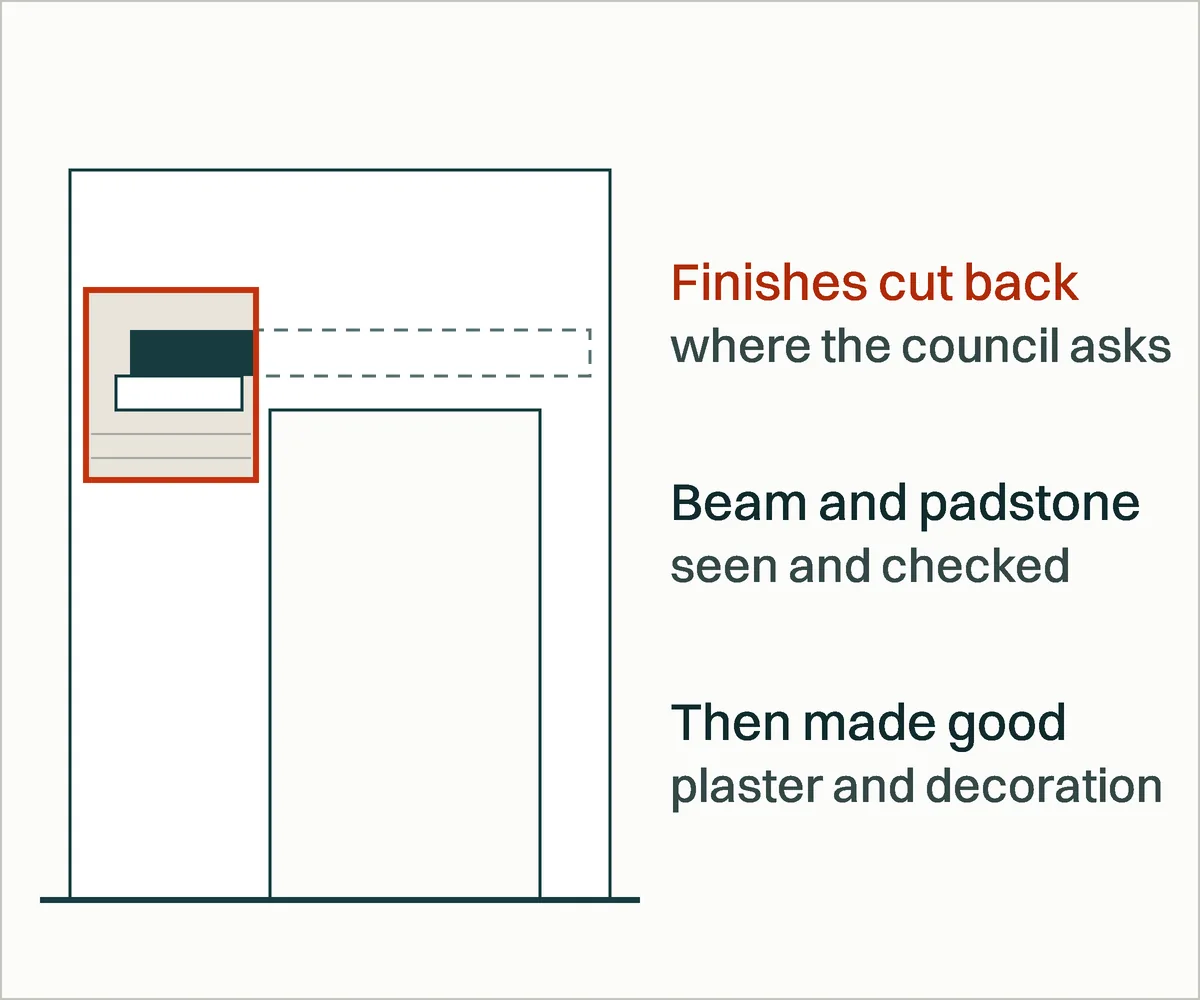
The council decides what is opened on each job. On common jobs these are the parts that end up behind the finishes, which is why a surveyor cannot judge them from inside the room.
| Job | Hidden once it is finished |
|---|---|
| Wall removed and a beam put in | The beam, the padstone or bearing under each end and any fire protection around it |
| Loft conversion | Floor joists and any steel, insulation in the roof slopes, fire protection to the floor and the stair enclosure |
| Extension | Foundations, the damp proof course, insulation in the floor and walls, drains |
| Chimney breast removed | The support to the chimney left above |
| Bathroom or kitchen moved | Waste pipes and how they join the soil stack |
Opening up is at the owner's cost, and Croydon spells out what happens if you refuse. If you apply "but elect not to expose the works", it cannot issue the certificate and will not refund the fee.
Send any photographs taken during the job, structural calculations and installers' certificates with the application. They show the surveyor what is behind the finishes, though the council still decides what it needs to see for itself.
What happens after the inspection?
The council replies with one of three answers under regulation 18:
- a list of the work needed to make it comply
- that it cannot tell what work is needed
- that no work is needed
Where work is needed, it has to be done before a certificate can follow. Camden warns that an owner may need to "make alterations before we can grant a regularisation certificate". Lambeth charges no extra fee for the certificate itself once the work has been certified.
How much does a regularisation certificate cost?
There are two costs, the council's fee and the building work. Each council sets its own fee. Lambeth publishes regularisation fees for common jobs on homes and works out a fee for anything else on request, and its surveyor "will not visit the property until a completed application form and fee has been provided". Croydon publishes its regularisation fees as a separate list.
The building work is the part nobody can fix in advance. It covers the opening up, any alterations the council lists, and making good the plaster, floors and decoration afterwards. A builder can price the opening up and the making good from a visit. The alterations can only be priced once the council has seen the work and written its list.
What about a loft conversion with no building regulations approval?
It goes through the same route as any other unauthorised work, provided it was built on or after 11 November 1985. A loft has a lot behind its finishes: the floor structure, the insulation and the fire protection are all covered. Our guide to converting a loft explains the parts of a loft room the regulations deal with, including the stairs and the escape route.
Can the council still take action over old work?
Yes, within limits. Under section 36 of the Building Act 1984 a council can serve a notice requiring the owner to pull down or remove work that breaks the regulations, or to alter it so that it complies. The owner has 28 days, or longer if a court allows it, after which the council can do the work itself and recover its reasonable costs.
A section 36 notice cannot be served more than 10 years after the work was completed. The 10 year limit came in on 1 October 2023 and applies to notices served since then, so ask your solicitor how it affects work finished long before that date. The same section says the limit does not stop a council, or anyone else, applying to a court for an injunction over work that breaks the regulations. GOV.UK adds that the person who did the work "could be prosecuted and fined".
Selling or buying a house without building regulations sign-off
GOV.UK puts the problem in one line: "Without approval you will not have the certificates of compliance you may need when you want to sell your home." Lambeth's advice to buyers is to make sure you are shown any completion certificates before you buy, since the responsibility comes with the property.
When a certificate is missing, the two routes people use are regularisation and an indemnity policy. An indemnity policy is insurance arranged through the conveyancing solicitor, and it does not inspect or fix anything. The HomeOwners Alliance describes it as covering the position you would be in if the council took enforcement proceedings. It also notes that these policies "become invalid if anyone makes an approach to the local council to ask about a lack of a building regulation certificate".
That condition affects the order you do things in. Speak to your solicitor before anyone contacts building control, because a call to the council can close off the insurance route. Which route suits a sale is a question for the solicitor and, on a purchase, the lender.
What a builder does during regularisation
The council inspects and decides. The builder's part is the physical work around those decisions:
- cutting inspection openings where the surveyor asks, as small and as tidy as the job allows
- being on site for the visit, so questions about the construction are answered at the opening
- pricing and carrying out the alterations on the council's list
- making good the plaster, floors and decoration afterwards
We take on this work across London. Vayton's engineer will come and look at the job without charge, and the visit commits you to nothing. Send the address, what was done and roughly when, and say whether a sale is under way. Attach any drawings or photographs you have. Read about our structural alterations and making good work, or send us the details.