
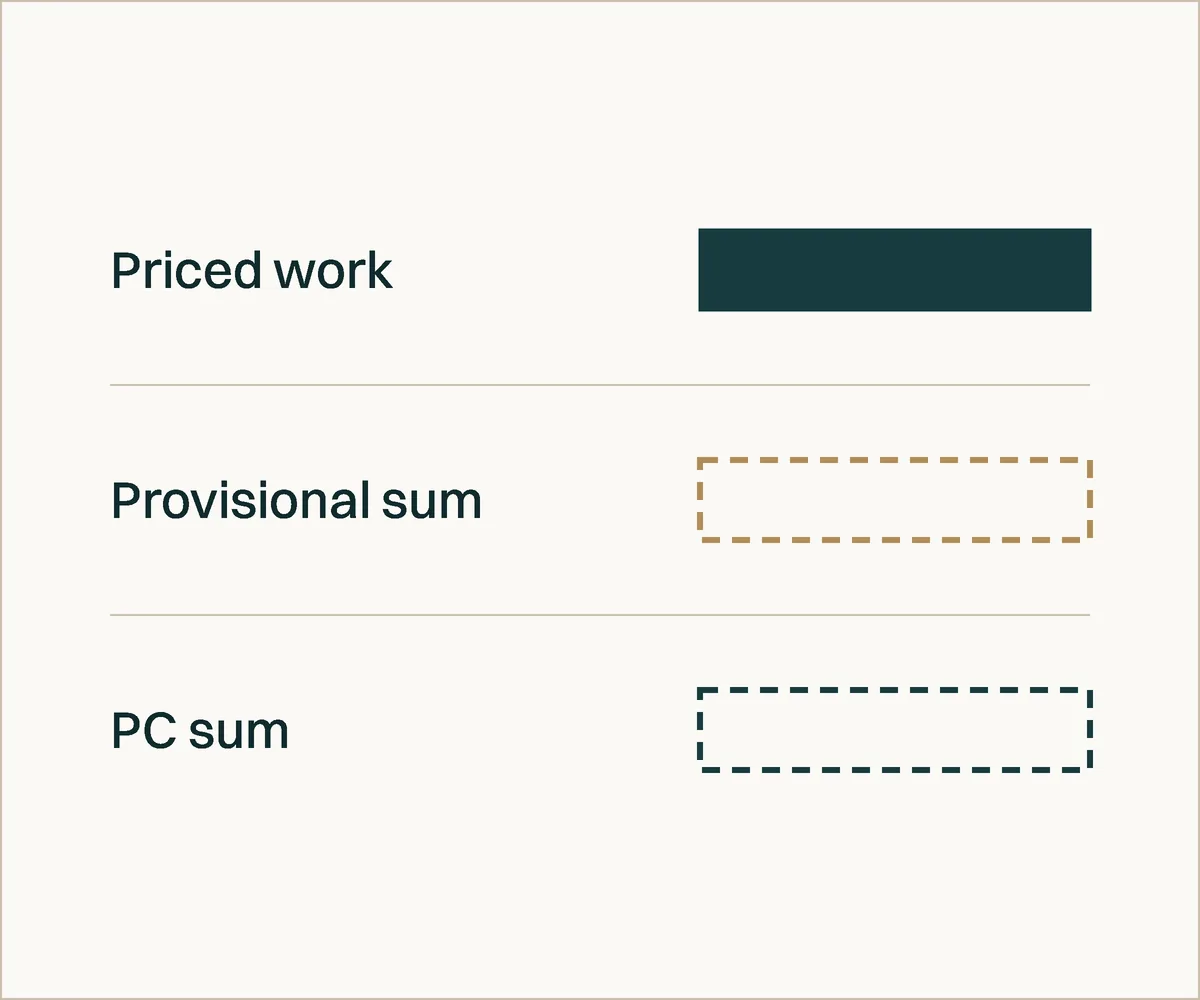
A provisional sum is an allowance in a quote for work that can't be priced properly yet, usually because something is hidden or not yet designed. A PC sum, short for prime cost sum, is an allowance for goods you haven't chosen yet, such as tiles or taps. Both are placeholders. When the real cost is known, the allowance comes out and the real figure goes in, so the total can go up or down.
What is a provisional sum?
A provisional sum is a figure the builder puts in for work nobody can measure yet, to be replaced later by the real cost. The RICS measurement rules split provisional sums into two kinds, and Designing Buildings sets them out. A defined provisional sum describes the work well enough for the builder to plan for it: what it is, how it is fixed, roughly how much there is, and any limits. The builder is expected to have allowed for it in the programme and the site costs. An undefined one is too vague for that, so the time and site costs it needs are not in the price either.
So an undefined provisional sum can cost time as well as money. If it turns into three extra weeks on site, the builder can ask to be paid for those weeks too, unless the quote says otherwise.
What is a PC sum?
A prime cost sum covers the supply of goods only. Under the same rules it leaves out fixing, the small materials that go with it, and the builder's overheads and profit, which are priced elsewhere in the quote. If your quote gives a PC sum for wall tiles at a stated price per square metre, that figure is the supply price of the tiles. Fitting them is a separate line. Choose a dearer tile and you pay the difference, plus the builder's percentage if the quote adds one. Choose a cheaper one and the quote should come down.
What do provisional sums look like on a real quote?
These lines come from a drylining tender we priced for a fit-out, with the amounts taken out.
| Wording on the tender | What it means |
|---|---|
| Door opening and lining labour, based on a "provisional allowance" of a stated number of reinforced openings and "subject to the coordinated door schedule and remeasurement" | The number of openings was not final. The rate per opening is fixed, and the count is measured again against the final door schedule. |
| Local plywood pattress, a "provisional local fixture-zone allowance" stated as "pending the coordinated fixing schedule" | Backing for wall-hung items was allowed as an area. The real area follows once the furniture and sanitaryware positions are drawn. |
Strictly, both lines are provisional quantities: the rate is fixed, the amount is provisional, and the line is measured again when the work is done. They still show what a clear allowance looks like. You can see what the work is, the unit it is measured in and what will settle it. A line that only says "provisional sum for unforeseen works" tells you none of those things.
How do provisional sums and PC sums change the final bill?
When the work is instructed, the provisional sum is taken out and the value of the work actually done is put in. The same happens to a PC sum when the goods are bought. Ask for that swap in writing each time, as a variation showing the allowance removed and the real cost added, so the running total is always visible. If the work is paid by the hour, the record behind it is a daywork sheet.
What should you ask before accepting a quote with provisional sums?
- What exactly does each allowance cover, and what is left out?
- What is it measured in: a number, an area, a length or a lump sum?
- What will settle it: a survey, a drawing, opening up, or your choice of product?
- Is the time and the site cost for that work in the price, or extra?
- For a PC sum, is fitting priced separately, and who pays for delivery and wastage?
Then add up the provisional and PC sums as a share of the total. Where a large part of a quote is provisional, that part is an estimate.
If you have a quote with allowances you can't follow, send it to us with the drawings. We can tell you which lines could be priced firmly from the information you have, and we reply within one working day. Send your quote and drawings.