
A Section 20 notice is a notice a landlord must send to leaseholders before carrying out major works to their building, when the works will cost any one leaseholder more than £250 through the service charge. The name comes from section 20 of the Landlord and Tenant Act 1985. The notices belong to a consultation with fixed stages, and a landlord who skips it may be unable to recover more than £250 from each leaseholder.
This guide covers England and the usual route for private landlords, resident management companies and right to manage companies. Councils and most housing associations follow a different route for high value contracts, and their leaseholders cannot nominate a contractor. The steps come from the Service Charges (Consultation Requirements) (England) Regulations 2003 and from the Leasehold Advisory Service (LEASE), both read on 19 November 2026. Vayton prices and builds this kind of work, so for advice on your own lease ask LEASE or a solicitor.
When does Section 20 apply?
It applies to what the law calls qualifying works. LEASE describes these as physical work on the building, such as repairs, maintenance and improvements, "that will cost any one leaseholder more than £250 (including VAT)". The figure is set by regulation 6. Where the service charge is not split equally, the test is the flat that pays the largest share.
LEASE gives an example: painting the outside of a block of 10 flats for £6,000 including VAT comes to £600 a flat, so the consultation is needed. The landlord has to consult "even if the leaseholders have agreed to the work". A separate rule covers contracts that last more than 12 months and cost any leaseholder more than £100 a year.
What are the stages of a Section 20 consultation?
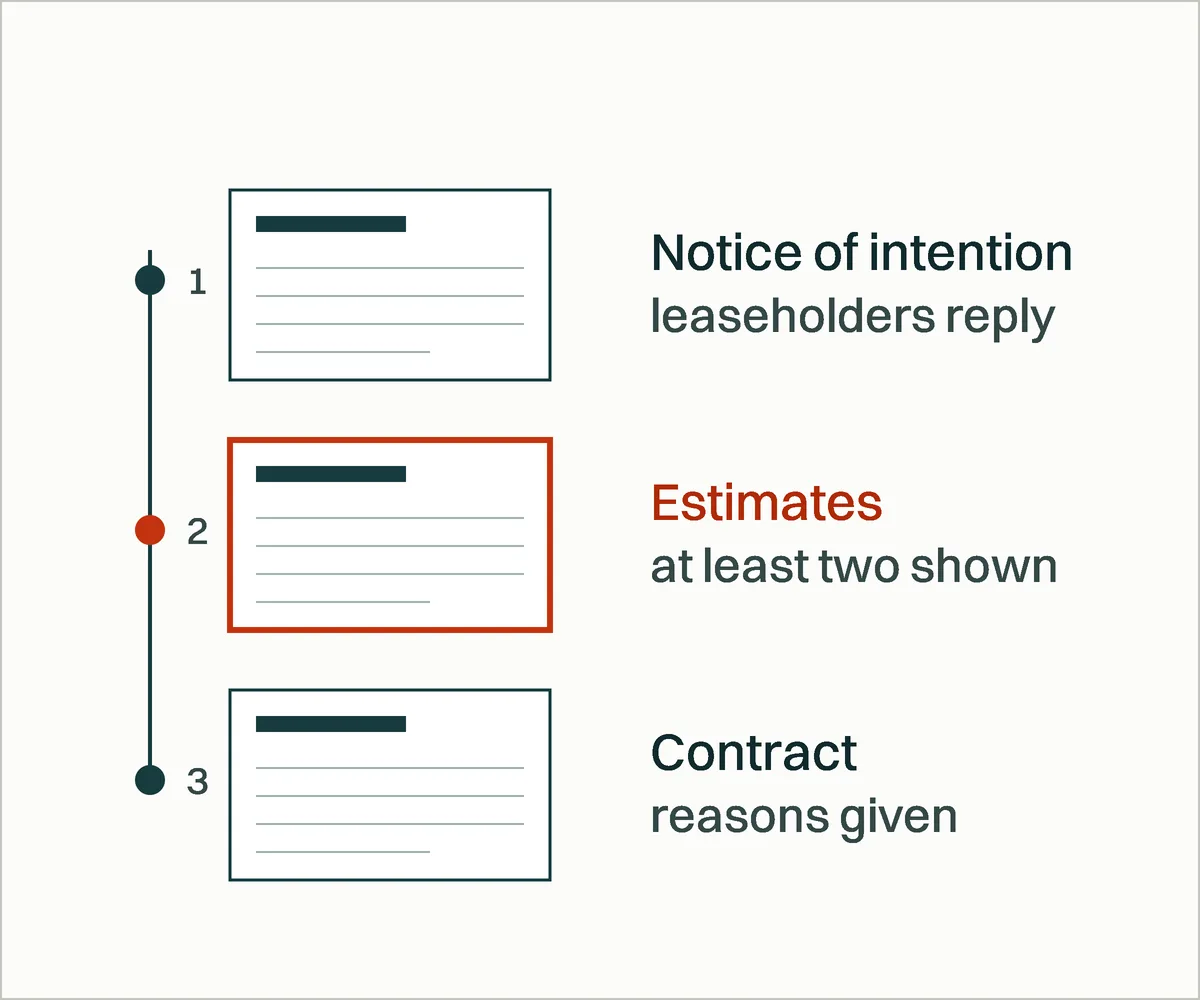
There are three notices, and leaseholders get two periods of 30 days to respond.
| Stage | What happens |
|---|---|
| 1. Notice of intention | The landlord describes the works, gives the reasons for them, invites written observations and invites leaseholders to nominate a contractor. Leaseholders have 30 days. |
| 2. Estimates | The landlord obtains estimates and sends a statement setting out at least two of them, with a summary of the observations received and its replies. Every estimate is open to inspection. Leaseholders have another 30 days. |
| 3. Notice of reasons | Within 21 days of entering into the contract, the landlord explains why it chose that contractor. This notice is not required where the contract goes to a nominated contractor or to the lowest estimate. |
The regulations define the response period as "the period of 30 days beginning with the date of the notice". LEASE adds that where a notice is posted, the tribunal has ruled its date should usually be treated as 2 working days after posting.
How long does a Section 20 consultation take?
LEASE says the process "takes several months". The two response periods alone come to 60 days, and the estimates have to be gathered between them. The works "cannot start until the consultation process is complete", in the words of LEASE's guide for right to manage companies.
For outside work that depends on the weather, count backwards from the start date. A scaffold that should go up in April needs the first notice out in January.
Can leaseholders nominate a contractor?
Yes, on the usual route. The notice of intention has to invite each leaseholder, and any recognised tenants' association, to propose "the name of a person from whom the landlord should try to obtain an estimate". Paragraph 4 of Part 2 of Schedule 4 then sets out what the landlord must do:
- where only one leaseholder makes a nomination, try to obtain an estimate from that contractor
- where a recognised tenants' association makes a nomination, try to obtain an estimate from its nominee
- where several leaseholders nominate different contractors, try the contractor with the most nominations, or one of those tied for the most
The duty is to try to obtain an estimate, so a nomination does not win the job. It does carry weight in two ways. An estimate from a nominated contractor must be one of those set out in the landlord's statement. And if the contract goes to a nominated contractor, the landlord does not have to serve the notice of reasons.
To nominate, send the contractor's details in writing to the address on the notice within the 30 days. LEASE suggests speaking to contractors first "to get their advice on the work or services and the costs they would expect to charge, before deciding which one to nominate".
What must the estimates show?
The regulations ask for three things. The landlord's statement has to give the estimated cost from at least two of the estimates. "At least one of the estimates must be that of a person wholly unconnected with the landlord", and the regulations list what counts as a connection, such as a contractor that shares a director with the landlord company. All of the estimates have to be available for leaseholders to inspect free of charge.
What a contractor's estimate needs for Section 20
The points below are our own practice, from pricing communal work such as the exterior repainting of a block in South Croydon for a managing agent in October 2026. They do not come from the regulations.
- Price the works in the same terms as the notice describes them, so leaseholders can compare the estimates item by item.
- Show the VAT, because the £250 test includes it.
- State how long the price stays open. It has to outlast both response periods and the time between them.
- Say what is provisional, such as repairs that can only be measured once the scaffold is up, and give the rate they will be charged at.
- Cover access: scaffold, any licences for it, working hours and how residents will be told.
- Attach insurance details and anything else the notice asked contractors to hold.
Our quotation checklist lists what to send a contractor before asking for a price.
What happens if the landlord does not consult?
The landlord may be limited to £250 from each leaseholder for the works, unless a tribunal grants what is called dispensation. LEASE explains that a tribunal "will only reduce your service charge if you lost money or rights", which it calls relevant prejudice, following the 2013 case of Daejan v Benson. Leaseholders would need to show what they would have said if they had been consulted properly, "such as suggesting changes to the planned work or nominating a cheaper contractor". The tribunal can also grant dispensation with conditions, such as the landlord paying the leaseholders' reasonable costs of the application.
What about urgent repairs?
A landlord can apply to the tribunal for permission not to consult. LEASE lists the situations where that is common: the works are very urgent, "such as if the building is unsafe, or if there is a serious leak in the roof"; all the leaseholders have already agreed the work needs doing; or only a few specialist contractors can do it.
Is Section 20 changing?
On 19 November 2026 the £250 threshold and the stages above were still the law, and legislation.gov.uk showed no outstanding changes to regulation 6. That day, in a written statement on the Commonhold and Leasehold Reform Bill, the minister said the government "will also reform the outdated major works process, including by making improvements to consultation procedures and restricting the grounds upon which landlords may seek dispensation". The statement gave no date for that reform. Check LEASE's current page before relying on a figure in this guide.
What we do
Vayton Construction prices and carries out communal works for managing agents, resident management companies and freeholders across London, including redecorating halls and stairs, outside repairs and painting, and plastering. We price to your specification in a form you can put in front of leaseholders, and leaseholders can nominate us at the notice of intention stage. Send the specification or a description of the works, the address and the number of flats. Read about our communal-area refurbishment and property maintenance work, or send us the details.