
Snagging is the inspection near the end of a job that lists small faults and missed items for the builder to put right before handover. Designing Buildings notes that the word is trade slang with no contract meaning, and that the inspection usually happens about two weeks before the work is declared complete. On a short domestic job it is more often in the last day or two. Most advice online is about new-build houses. On a refurbishment or fit-out you are mostly checking where new work meets old.
What counts as a snag?
A snag is a small, visible fault that is quick to fix.
| What you find | What it is |
|---|---|
| A paint miss, a rough filled joint, a door that catches | A snag: small, visible and quick to fix |
| A whole item in the quote that has not been done | Unfinished work. It is completed before the list is closed. A small missed item, such as a door stop, goes on the list |
| A leak, a crack that comes back, a floor that lifts | A defect. The cause has to be found, and it can appear after handover |
| Something you now want done differently | A variation, priced separately |
What should you look at on walls and ceilings?
On ceiling and partition work, the usual snags are at edges and joints. Look along each surface with a light held close to it.
- board joints or screw heads showing through the paint
- edges where a ceiling meets a bulkhead, a wall or a different type of ceiling
- beads and trims that are not straight or not fully filled
- changes of level across a long ceiling
- access panels that do not sit flush or do not open
- paint cut in poorly at junctions
- gaps at the head or the base of a partition
What should you check in the rest of the room?
Work through each room the same way, fixture by fixture.
- doors that close and latch without catching
- joints in skirting and architrave
- tile cuts, grout and sealant lines
- taps and wastes, run with water and checked for drips
- sockets, switches and lights that are level and working
How should a snag be recorded?
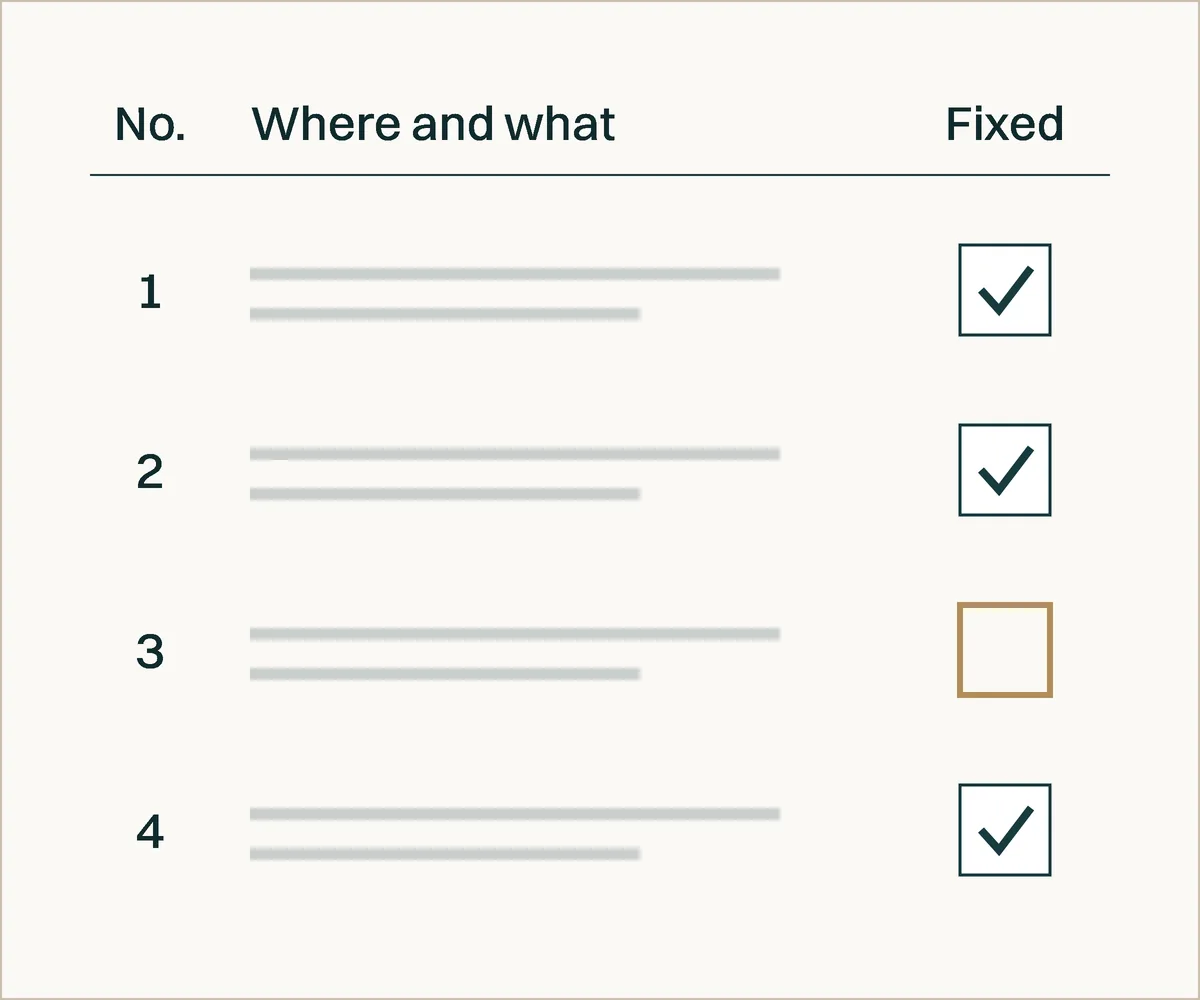
One line per snag: the room and the exact place, what is wrong, a photograph, who is to fix it and by when. Number them. When the builder says they are done, walk the list again and tick each one off on site. A list with no locations or photographs turns into an argument about which mark was meant.
What does a snag list look like?
One draft snag list ran to more than 70 numbered items. Most were grouped by trade. Each line had a number, a location, the problem and, for most, a photograph. Items to order were listed separately, and a snag that needed one gave its order reference. These entries are reworded from that list.
| Where | Entry |
|---|---|
| A column | Gaps around the column still to be painted |
| A light fitting | Gap around the fitting to be made good |
| A panel | Paint showing through the finish |
| All speakers and lights | Check that none have been painted over |
To make your own, print our snag list with a worked example (PDF, 2 pages). Page one shows a kitchen refurbishment as the example and page two is blank.
What happens to faults found after handover?
Handover starts the period in which the builder can be called back for defects that appear later. Faults you can already see should be on the snag list and fixed before handover, because a mark found months later is hard to tell from wear or damage. Ask how long that period is before the job starts. Ours is set out in our guarantee.
Review, snag and hand over is the last step in how we work. If you want the snag walk-round written into your quotation, say so when you send us the drawings. We reply within one working day.