
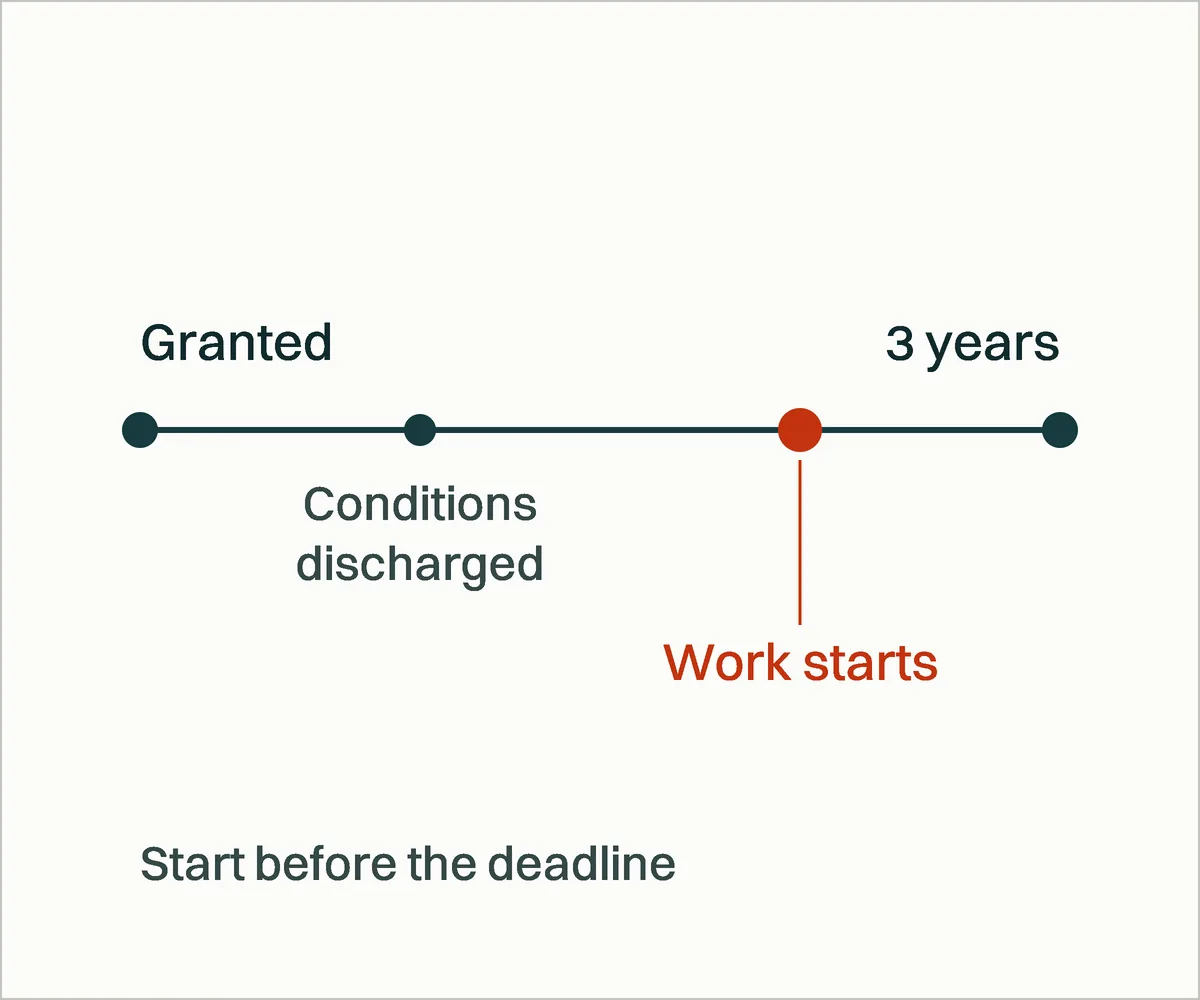
How long does planning permission last? In England, normally three years. Section 91 of the Town and Country Planning Act 1990 makes every permission subject to a condition that the development "must be begun not later than the expiration of" the applicable period, which for England is three years from the date the permission is granted. The council can set a longer or shorter period, so read the first condition on your decision notice. The rules below were checked against legislation.gov.uk and government guidance on 17 November 2026.
When does the three years start?
From the date on the decision notice, not the date you applied and not the date you received the letter. If the permission was granted on appeal, the date is the date of the appeal decision.
What counts as starting work on a planning permission?
A material operation. Section 56 of the same Act says the development begins on the earliest date a material operation is carried out, and lists what that means:
- any work of construction in the course of the erection of a building
- any work of demolition of a building
- the digging of a trench which is to contain the foundations, or part of the foundations, of a building
- the laying of any underground main or pipe to the foundations, or to such a trench
- any operation in the course of laying out or constructing a road
- any change in the use of land which is material development
For a house extension, digging the foundation trench for the approved extension is the usual way to start. Clearing the site, putting up hoardings or a soil test is not normally enough. The work has to be part of the approved development, in the approved position.
Do conditions have to be discharged before you start?
Yes, if the permission has pre-commencement conditions. These are conditions that say "no development shall take place until" something is approved, such as materials samples, a construction management plan or drainage details. Government guidance on the use of planning conditions describes them as conditions that "prevent any development authorised by the planning permission from beginning until the condition has been complied with". If you dig the trench before they are discharged, the start may not count, and the permission can still expire. Councils commonly take up to eight weeks to discharge a condition, so apply well before the deadline.
Does planning permission expire once work has started?
No. Once the development has lawfully begun within the time limit, the permission stays alive even if the work then stops for a while. What can still lapse is the practical side: building regulations approval, the party wall award, the build over agreement and the contractor’s price. To have written proof that the start counted, you can apply to the council for a lawful development certificate for the works carried out.
How long does outline planning permission last?
Outline permission works in two stages, and section 91 does not apply to it; section 92 does. The usual pattern is that the reserved matters (such as appearance and layout) must be applied for within three years of the outline permission, and the development must begin within two years of the final reserved matters approval. Outline permission is rare for house extensions and common for new homes and larger schemes.
Does permitted development have a time limit?
Not in the same way. Section 91 says its time limit does not apply to planning permission granted by a development order, which is what permitted development is. A larger rear extension approved through prior approval still has to be built as described in the application, so building something different needs a fresh check.
Can planning permission be extended or renewed?
There is no simple extension of time for an ordinary permission. The options are:
| Option | What it does |
|---|---|
| Start in time | Discharge the pre-commencement conditions and carry out a material operation before the deadline |
| New application | Apply again for the same development. The council decides it under the policies in force at the time, which may have changed |
| Section 73 application | Changes or removes a condition. It creates a new permission, but section 73 does not allow the time limit for starting to be extended |
| Non-material amendment | A small change to the approved drawings under section 96A, without a new application |
Since 18 February 2026, changes made by the Planning and Infrastructure Act 2025 to section 91 also extend the time limit when a permission is challenged in the courts. For example, it is extended by two years if a party is given permission to appeal to the Supreme Court. That rarely affects a householder application.
How long does it take to get planning permission?
The statutory period for a householder application is eight weeks from the date the council validates it. Our planning permission cost guide covers fees and timescales. Then add the time to discharge conditions, agree party wall matters and get building regulations approval, which can add several months between the decision and the first day on site.
What should you plan if permission is close to running out?
Work backwards from the expiry date:
- List the pre-commencement conditions and submit the details for all of them in one go.
- Serve party wall notices at least two months before any party wall work, and check whether a Thames Water build over agreement is needed.
- Get the building regulations application in, so the foundation design is approved.
- Book the groundworks so the trench for the approved extension is dug and inspected before the deadline, and photograph it with a date.
What happens if you build after planning permission has expired?
The work is then unauthorised development. The council can ask for a retrospective application or take enforcement action, which can require changes or removal. A buyer’s solicitor will also find the gap, because the permission on file no longer covers what was built. If you are past the deadline and have not started, apply again before building rather than after.
Does building regulations approval expire too?
Yes. Under section 32 of the Building Act 1984, as rewritten in 2023, if the work has not started within three years of the day the building control application was made, the law treats the application as never made and the approval as never given. Planning permission and building regulations approval run on separate clocks, so check both dates. Party wall notices also lapse if work does not start within a year of being served, according to the government’s Party Wall Act booklet.