
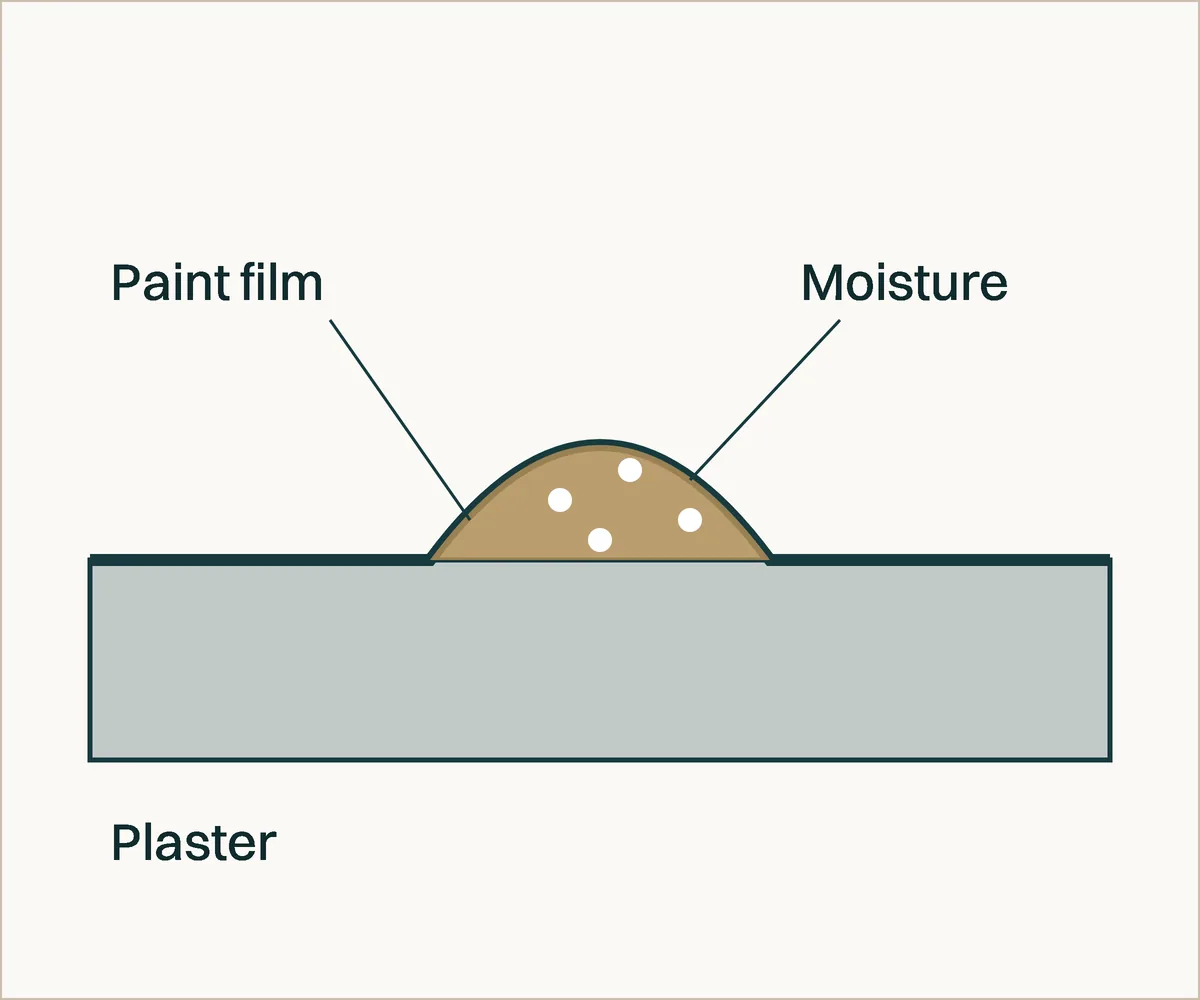
Paint bubbling on walls, or blistering, happens when something lifts the paint film away from the surface beneath it. Dulux's guide to paint problems lists the first cause as "moisture trapped beneath the surface of the paint film". The moisture can come from the wall, from the air in the room, or from the plaster itself if it was painted too soon.
Why is my paint bubbling?
Paint usually bubbles because moisture is getting behind it, from the plaster, the room or the wall.
| Where and when | Likely cause |
|---|---|
| On new plaster, soon after painting | The plaster was still damp, or it was painted without a thinned first coat. Dulux says emulsion applied to wet plaster is likely to crack and peel, and that plaster can take up to four weeks to dry. Our guide on how long after plastering you can paint sets out the checks |
| In a bathroom or kitchen | Steam condensing on the wall, often with too little extraction |
| Low on a wall, or around a window | Damp coming through the wall |
| On a ceiling below a bathroom or tank | A leak from above. See our guide to painting a ceiling after a water leak |
| Tiny craters across fresh paint | Foaming. Dulux explains that air gets into the wet paint and the bubbles burst, leaving craters |
| On old paint that is also flaking | Movement or cracking letting moisture in, or a new coat that has not bonded to a dirty or glossy surface |
Why does paint stain or bubble on a chimney breast?
Often because of salts left in the chimney by old fires, though rain getting in at the top of the stack can leave similar marks. The SPAB explains that hygroscopic salts "can also be deposited within chimney flues from combustion gases and will remain long after flues have been disused, causing dampness on plasterwork around chimney breasts". These salts absorb moisture from the air, so the patch tends to look worse when the weather is muggy. Because the salts stay in the wall, repainting on its own rarely cures it. The SPAB says removing the plaster can be an option, but if it is replaced before the wall has dried out "the new plaster is likely to become contaminated by salts retained in the wall".
How do you fix bubbling paint?
Stop the moisture first, then repair the paint.
- Find and stop the source of the moisture. Repainting over damp brings the bubbles back. If you cannot find where the damp is coming from, ask a surveyor to trace it.
- Let the wall dry out fully.
- Scrape off the loose paint back to a firm edge, as Dulux advises, then smooth the edges with wet abrasive paper and fill. In a house built before the 1980s, read the lead advice below first.
- Prime the bare patches with a primer suited to the surface.
- Repaint the whole wall, so the repair does not show.
Is it safe to scrape or sand old paint?
In older homes, check first. The HSE lists removing paint in properties built before the 1980s, stripping with blow lamps or gas torches, and dry sanding old paint as the jobs that put people most at risk from lead. It advises stripping old paint only where it is flaking, chipping or a risk to children, and using wet abrasive paper. Textured coatings from before 1999 should not be sanded at all, as our guide to cracks in a ceiling explains.
Tell us where the bubbles are, when the wall was last painted and whether there has been a leak or damp, with a photo if you have one. We reply within one working day. Get the wall looked at.