
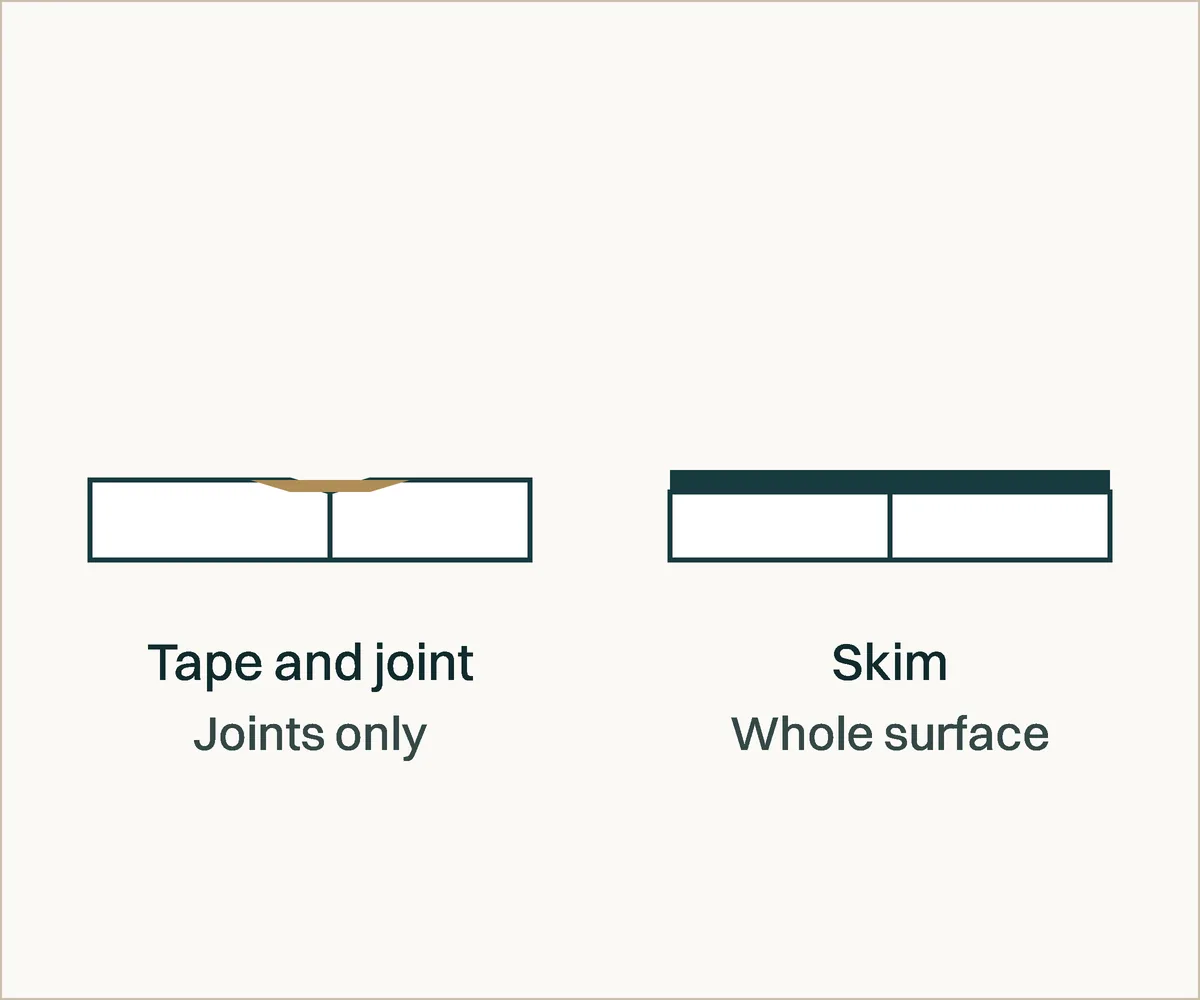
Tape and jointing, also called taping and filling, treats only the joints between plasterboards and the screw heads. Skimming covers the whole wall or ceiling with a thin coat of finish plaster. Both end with a smooth surface ready to decorate. Which one fits depends mostly on the board edges, the room and the timetable.
What is tape and jointing?
Tape and jointing is a dry finish for tapered edge plasterboard. British Gypsum's finishes guidance says the tapered edges "provide a recess for the joint treatment, allowing a flat, finished surface". The joint is bedded with tape, filled, left to set, given a finishing coat and sanded smooth. British Gypsum recommends its joint tape "for the best crack resistance", because some movement between boards is normal.
Square or cut edges are harder to hide. There, the same guidance says, the joint treatment "is inevitably raised above the board surface and is more difficult to conceal", so it is feathered out wider across the board.
What is skimming?
Skimming is a wet plaster finish. A plasterer trowels a thin coat over the whole surface and polishes it as it sets. British Gypsum gives a maximum thickness of 2 mm for Thistle MultiFinish. Its finishes guidance says the joints "must be reinforced", with Gyproc Joint Tape giving the greatest resistance to cracking and Thistle ProTape as the alternative.
How is tape and jointing different from a skim?
Tape and jointing finishes only the joints, while a skim covers the whole surface with plaster.
| Point | How they differ |
|---|---|
| Boards | Tape and jointing needs tapered edge boards for a flush joint. A skim can go over square or tapered edges |
| Who does it | A taper and jointer, often as part of a drylining package, or a plasterer for a skim |
| Drying | Jointing compound goes on joint by joint in thin coats, each left to set or dry before the next. A skim is one wet coat over the whole surface, and the whole wall has to dry before painting. Our guide to painting new plaster covers drying |
| Moisture resistant board | British Gypsum's data sheet says you should normally avoid skim plaster on moisture resistant board. Where it is skimmed, British Gypsum says to plaster the face only and pre-treat it with Thistle Bond-it |
| Surface | A skim gives one plaster surface across the wall. A jointed wall has board face and jointing compound side by side, so British Gypsum says to prime the whole surface with its Drywall Primer, joints and board alike, before painting |
Should you tape and joint or skim plasterboard?
Tape and jointing suits new stud walls and ceilings on tapered edge board, and a skim suits rooms where new board meets old plaster. In offices, shops and nurseries tape and jointing is common because the drylining team can finish the boards without a plasterer, and there is no wet coat over the whole surface. In houses a skim is often chosen so the whole wall has one even surface. Where old walls are rough, lining paper is another option, and our guide to lining paper or skimming compares the two.
Ask which finish has been priced. A quote that says "boarded and finished" can mean either.
Tell us which rooms are being boarded and whether you want them skimmed or jointed, or ask us to suggest a finish for each. We reply within one working day. Ask about your walls.