

A noggin, also called a nogging, is a short horizontal piece fixed between two studs in a wall or two joists in a floor. Designing Buildings describes a nogging as a strut "used to give rigidity to a framework, typically fixed between joists or studs". Noggins are usually timber, but they can also be metal. In Scotland they are called dwangs.
What are noggins for?
Noggins stiffen the frame, support the edges of the boards and give a solid fixing, and one noggin often does more than one of these jobs.
| What the noggin does | Where it goes |
|---|---|
| Stiffens the frame | Between studs part way up a tall wall, or between joists, so the timbers do not twist or bow |
| Supports board edges | Behind each horizontal joint where two plasterboards meet, so both edges can be screwed |
| Gives a fixing | Behind anything that will be screwed to the wall: radiators, wall cupboards, handrails, a television bracket |
The third job has to be planned before boarding. Plasterboard on its own is a poor fixing for heavy items. A noggin or a sheet of plywood behind the board gives the screws something to bite into, and our guide to backing in stud walls covers the heavier cases.
How far apart should noggins be?
No single spacing suits every wall, because the position depends on what each noggin is for.
- Board edges: wherever boards meet horizontally. A wall taller than the boards has a horizontal joint, and that joint needs support behind it.
- Stiffness: a row part way up a tall wall, where the wall designer or the board maker calls for it.
- Fixings: at the exact height of each item, measured from the finished floor level.
In timber walls the noggins are often staggered slightly, one above the next, so each can be fixed through the stud from both ends. For a fire-rated or acoustic wall, build to the board maker's published details, because the rating only applies to the wall as it was tested.
Do metal stud walls have noggins?
Yes, made from the system's own metal parts. British Gypsum's GypWall details, for example, use a metal fixing strap "to support horizontal board joints in face layer of multiple layer board linings". Where something heavy will hang, plywood or timber backing is fitted between the studs before boarding.
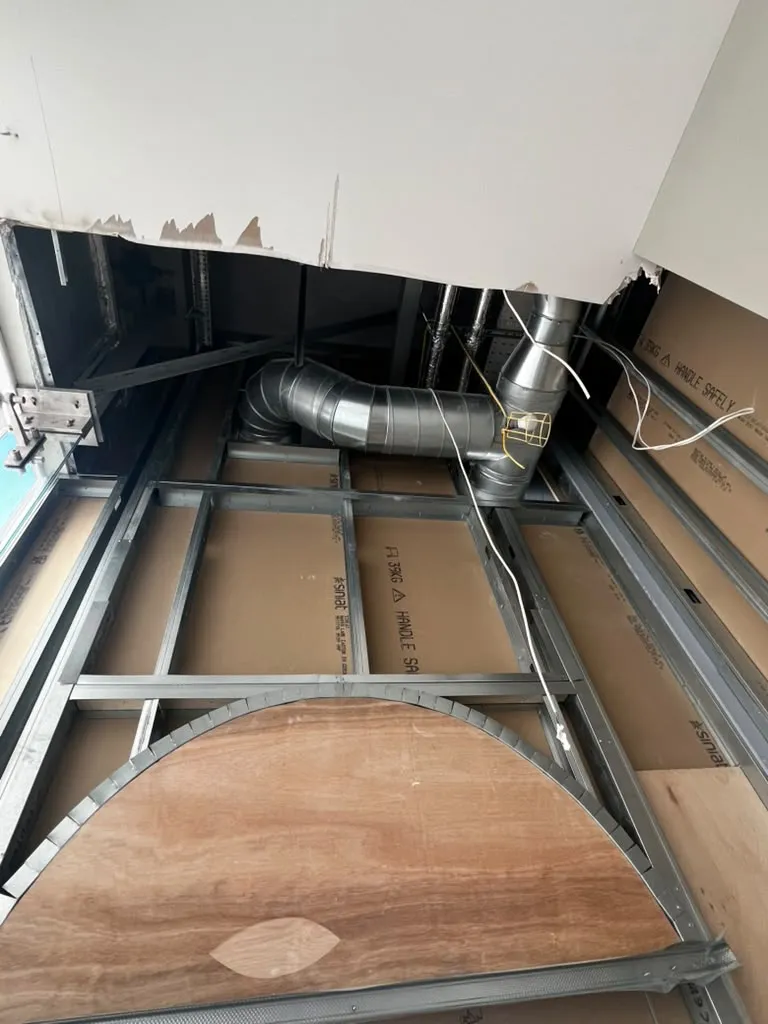
At IQ Nursery in Ealing the arched openings were framed in metal with horizontal sections across the top, and in the photo a curved plywood piece forms the head of the arch. The boards on the far side were already fixed. The case study has more photographs of that stage.
Where do you need noggins for a TV, radiator or cupboards?
Behind every item that will be screwed to the wall, at its exact height.
- shelves, wall cupboards and kitchen wall units
- radiators and towel rails
- a television bracket or a media wall
- grab rails and handrails
- blinds, curtain poles and large mirrors
Mark each one on the drawing with its height. Once the wall is boarded, adding a noggin means cutting the board open. Our guide to first fix and second fix lists the other decisions that belong at this stage.
How do you find noggins in an existing wall?
Use a stud detector, or look for rows of screw heads or filled dimples in the board, which show where it is fixed to the frame. A horizontal row between two studs usually marks a noggin or a board joint. Check for cables and pipes with a detector before drilling.
Send us the layout and a list of what will hang on the new walls. We will price the studwork with the noggins and backing where they are needed, and we reply within one working day. Send your layout.