
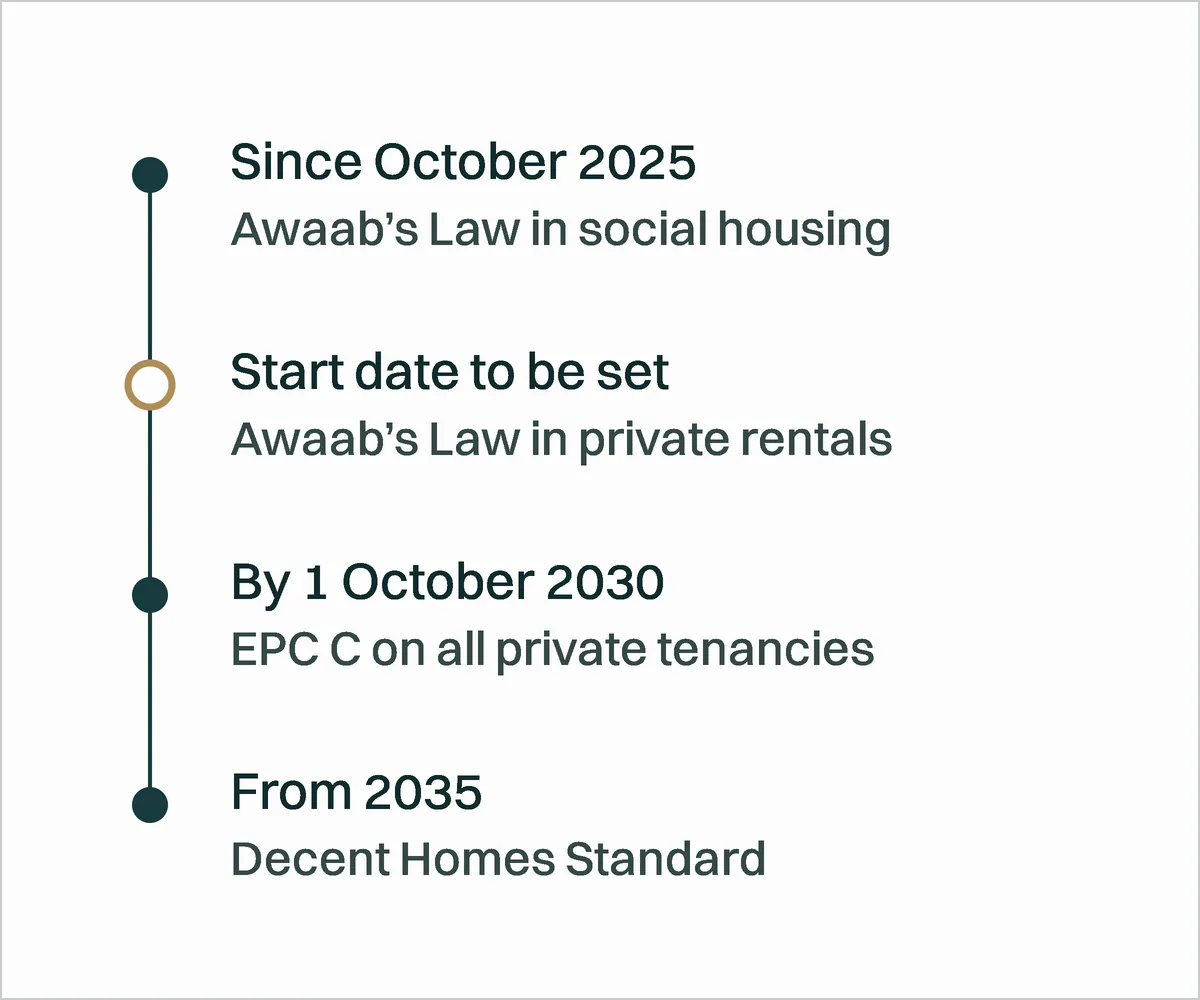
Awaab's Law is named after Awaab Ishak, a two-year-old who died in 2020 after long exposure to mould in his family's social housing flat in Rochdale. No start date has been set for private tenancies yet, and the repairs that stop damp will be the same whatever the final rules say. If a tenant has already reported damp, send us photographs and the postcode and we will reply within one working day.
Does Awaab's Law apply to private landlords?
Not yet. This is where each sector stands.
- Social housing has been covered since 27 October 2025, starting with significant damp and mould hazards and all emergency hazards.
- A second phase, due on 30 November 2026 if Parliament approves it, adds hazards such as excess cold and heat, falls, electrical, fire and structural collapse. The remaining hazards, except overcrowding, follow in 2027.
- Private tenancies are in a government consultation that runs from 9 October to 18 December 2026. It uses the social housing rules as the starting point and proposes covering every hazard except overcrowding. The start date and any phasing will be decided after it closes.
Awaab's Law timescales for social landlords
These are the deadlines social landlords work to now. The government's consultation makes a case for the same deadlines for private landlords and asks whether any should be shorter or longer.
| Step | Deadline for social landlords |
|---|---|
| Investigate a potential significant hazard | Within 10 working days of becoming aware of it |
| Give the tenant a written summary | Within 3 working days of the investigation |
| Make the home safe | Within 5 working days of the investigation |
| Start preventative work | Steps within 5 working days, physical work within 12 weeks |
| Emergency hazards | Investigate and make safe within 24 hours |
This page is a summary, not legal advice. We checked it against gov.uk on 6 November 2026, so look there for the final rules.
Two more standards coming for private rentals
Private landlords must reach an EPC rating of C on all tenancies by 1 October 2030, with spending capped at £10,000 per property, under the government's energy performance response. The new Decent Homes Standard will apply to private and social rented homes from 2035, enforced by councils in the private sector, and it includes damp and mould, repair and warmth.
What causes damp in London rented homes
- Water getting in: roof and gutter leaks, cracked render and failed pointing on old brick walls.
- Leaks inside: dripping pipes, and failed seals around baths, showers and sinks.
- Rising and penetrating damp at the base of walls, often from blocked air bricks or garden and path levels raised above the damp-proof course.
- Condensation: steam from cooking, showers and drying clothes with no extractor fans or blocked vents, settling on cold solid walls.
For a serious or unexplained damp problem, a damp survey finds the cause before money is spent on the wrong repair. We arrange the survey with a specialist where one is needed.
Repairs that stop damp coming back
- Stop the water first. Fix roof and gutter leaks, and get leaking pipes and seals fixed by a plumber.
- Improve ventilation. Extractor fans in the kitchen and bathroom, ducted outside and fitted by a qualified electrician we arrange, and clear air bricks and window vents.
- Warm the coldest walls. Internal wall insulation on solid external walls cuts condensation and helps towards the EPC target.
- Make good once the cause is fixed. Damp-damaged plaster is hacked off and replastered, then mould is treated and stains are sealed before redecorating.
- Keep a record. Dated photographs and a note of the work done help if a tenant raises a complaint.
Damp repairs and refurbishment for landlords
We repair and refurbish rented homes and HMOs across London, from roof leaks to replastering, insulation and redecorating between tenancies, as our landlord refurbishment and property maintenance pages explain. Leaking pipes and seals are fixed by our own plumber in south, north and east London. Photographs of the damp with the postcode are enough for us to tell you the next step.