
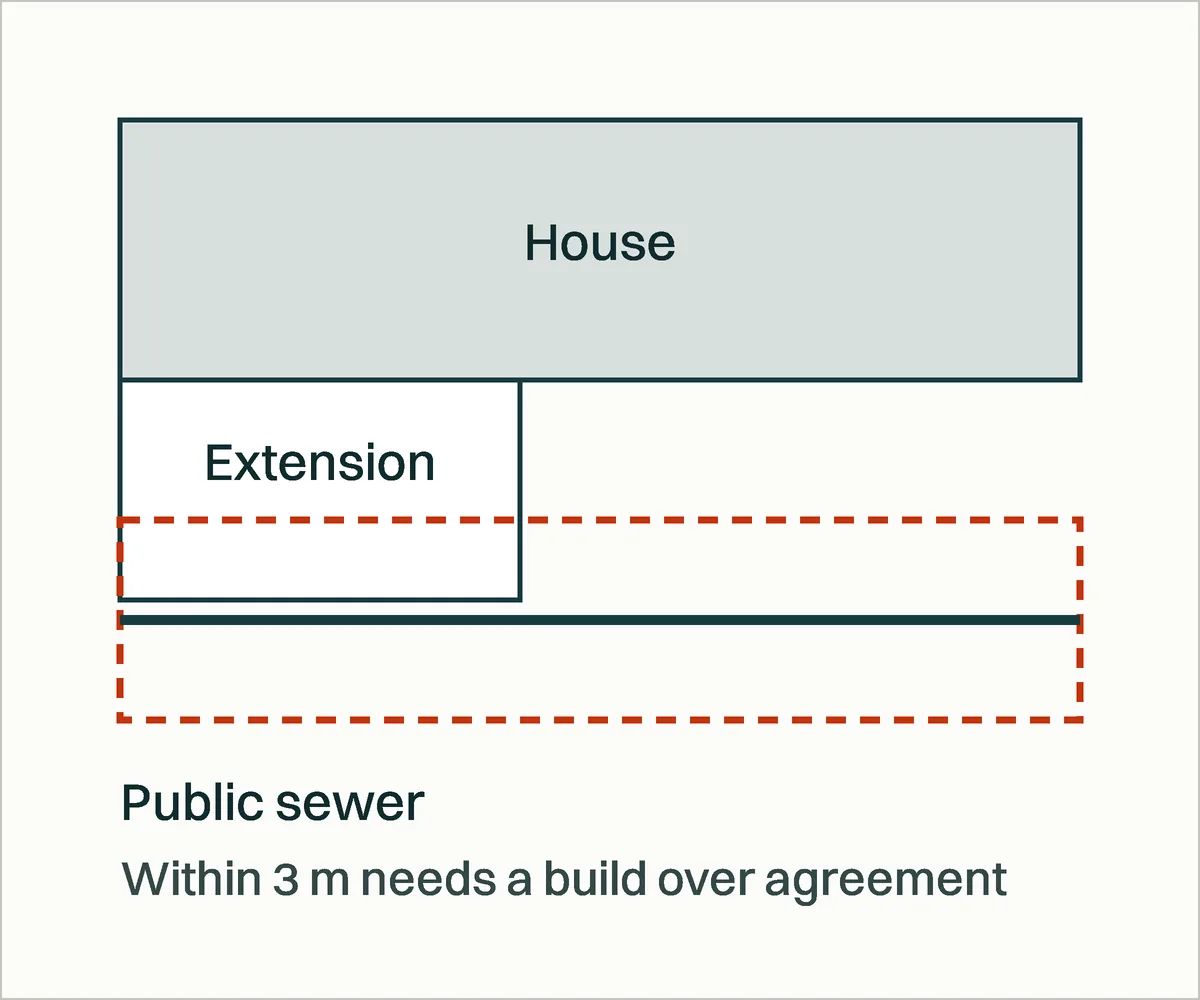
A build over agreement is a contract between you and your sewerage company when you build over or near a public sewer. In most of London that company is Thames Water. The agreement protects the sewer and gives Thames Water access to maintain it. Thames Water says you "shouldn’t start construction work before getting an agreement", and that planning permission "does not grant you permission to build over a sewer or drain". The details below come from Thames Water’s homeowner pages, read on 17 November 2026. Fees are updated every 1 April, so check the current figures before you apply.
When do you need a build over agreement?
When you build within 3 metres of a public sewer, or within 1 metre of the point where a pipe serving only your property crosses your boundary and becomes a public lateral drain. Thames Water’s build over page says sewers "often run beneath back gardens, particularly in urban areas", which is why so many London rear extensions need one. On a terrace, the drains from several houses usually join in a shared sewer behind the houses or under the gardens, and that shared pipe is public.
What is the difference between a public sewer and a private drain?
It depends on how many properties the pipe serves and where it is:
| Pipe | Whose it is |
|---|---|
| Drain | A pipe serving one property, inside that property’s boundary. Private, the owner’s responsibility |
| Lateral drain | A pipe serving one property but outside its boundary. Public, maintained by Thames Water |
| Sewer | A pipe serving two or more properties. Public in most cases, maintained by Thames Water |
Many shared pipes that were private before October 2011 became public then, which is why houses built long ago have public sewers in their gardens.
How do you find out where the sewer is?
Thames Water suggests two routes: your builder or a drainage specialist can survey the drains within the property boundary, and Thames Water’s sewer maps can be viewed free of charge by appointment or bought through a property search. Lifting the manhole covers shows the direction of the pipes. A CCTV drain survey shows the route, depth, size and condition of the pipe, which is what the engineer needs to design the foundations. Our drain survey guide explains how to brief one.
What does the application need?
Thames Water’s application page asks for three drawings for every class of agreement:
- a location plan showing the boundaries between your property and the neighbours
- existing and proposed building and drainage layout plans, showing the sewer pipes, manholes, flow direction and private connections
- a sectional drawing showing the foundation design, sizes and depths against the sewer, with bridging details for trench or strip foundations and invert levels where relevant
Piled foundations need a piling method statement and raft foundations need structural calculations. You also need the internal diameter of the sewer, which is why the survey comes first.
How much does a build over agreement cost?
The fee depends on the size of the sewer. Thames Water’s current charges, updated each 1 April:
| Class | Fee and sewer size |
|---|---|
| Class 1 | £130, sewer internal diameter 175 mm or less |
| Class 2 | £490, sewer from 176 mm up to 350 mm. The application page gives the upper limit as 375 mm in another section, so confirm the class with Thames Water if your sewer is between the two |
| Class 3 | £585, larger sewers, plus legal costs starting at £1,000 |
Applicants entitled to disability benefit receive a £130 discount with proof of entitlement. The fee does not include the drain survey, the engineer’s design or any extra foundation work the sewer causes.
How long does a build over agreement take?
Thames Water says its technical team reviews an application within 21 days of submission and payment. For Class 1 the agreement is then issued and work can start. Class 2 needs CCTV surveys before and after construction, usually arranged within 10 days each; Class 3 needs engineer surveys and legal agreements, and Thames Water says the full process "can take more than 3 to 6 months". Missing documents put the application on hold, so submit everything at once.
When can’t you build over a sewer?
Thames Water lists three cases:
- a manhole inside the area of the extension has to be relocated, because internal manholes are not permitted
- strategic sewers, the most important in the network, which Thames Water is unlikely to let anyone build over
- rising mains, pressurised pipes that pump sewage, which cannot be built over and have to be diverted
A minor diversion is possible for sewers of 150 mm internal diameter or less where the diversion is 20 metres or shorter. It needs CCTV surveys before and after and a refundable deposit of £2,000.
How are foundations built near a sewer?
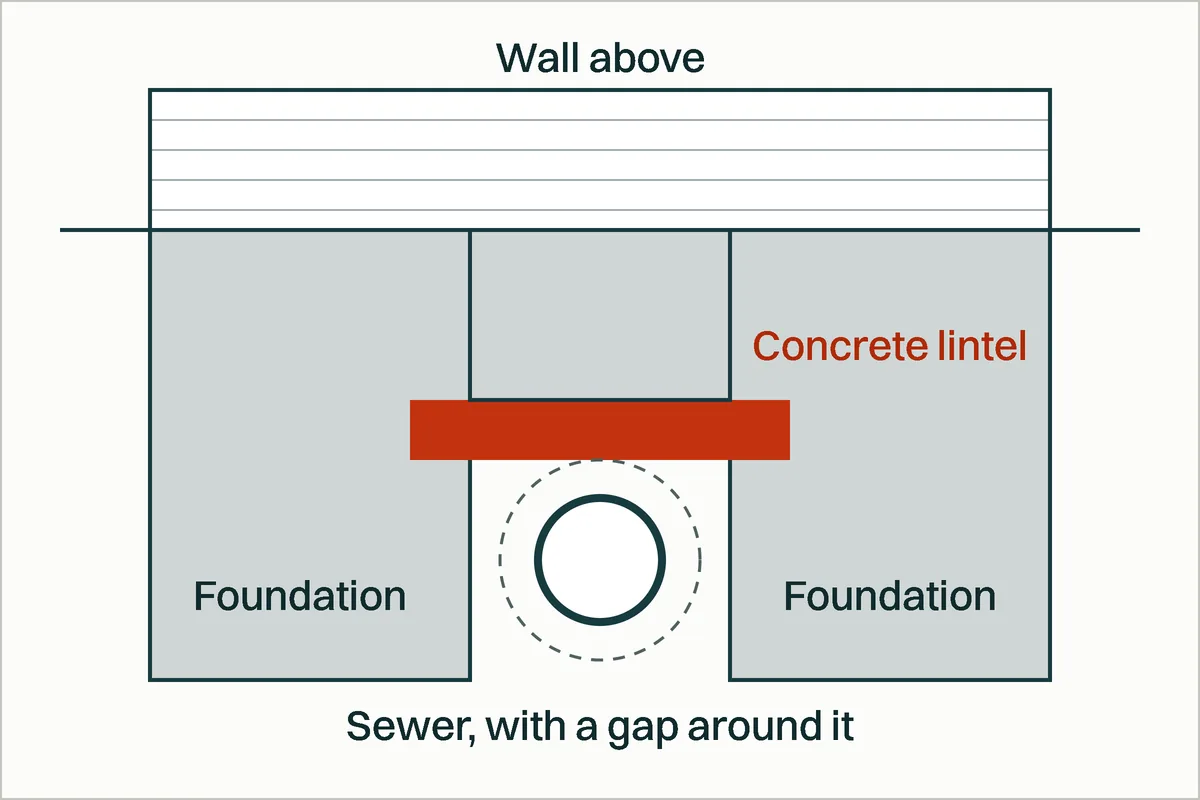
The foundation is designed so the new building does not load the pipe and the pipe can still be reached or replaced. Thames Water’s application asks for a section showing the foundations against the sewer, and for trench or strip foundations it asks for the bridging details: how the foundation spans over the pipe instead of bearing on it, usually with a reinforced concrete lintel or beam and a gap around the pipe. Where the sewer is deep or large, the engineer may use piles or a raft, which need a piling method statement or structural calculations with the application. Thames Water’s technical specification sets out its requirements, so the engineer should design to it from the start.
Who applies for the build over agreement?
The application asks for the property owner’s details and the applicant’s, so it can be made by the owner or by someone acting for them, such as the architect, engineer or builder. Whoever applies, the drawings come from the design team, and the agreement is registered against the property. Thames Water advises keeping the agreement with your records because it may be needed when you sell.
What happens if you build without one?
Thames Water says you may not be granted a building regulations completion certificate, which can cause problems when you sell. It has legal powers under the Water Industry Act 1991 to maintain and repair public sewers, and says that if building work limits this it "could seek an injunction to remove the building and potentially recover damages". Retrospective applications are possible, but they need a survey to show the sewer was not damaged and "may not be approved if our pipework was not properly protected". Liability for damage caused to the sewer during construction lies with the person building.