
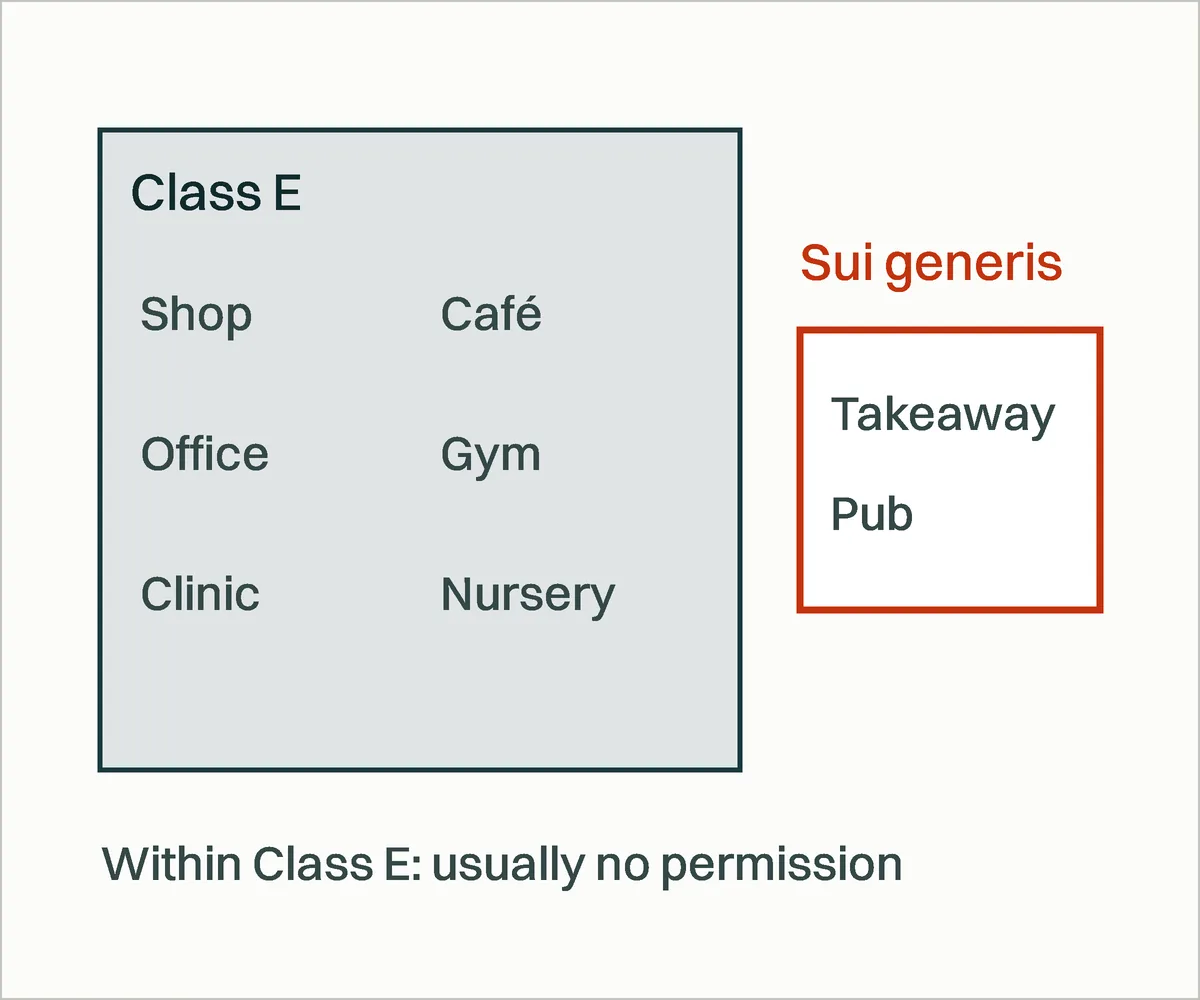
Every building in England has a use class under the Town and Country Planning (Use Classes) Order 1987. The class matters when you take on a unit, because changing from one class to another generally needs planning permission, while changing within a class generally does not. The current classes were last updated on 1 September 2020, when most high street uses were grouped into a single Class E. The class definitions below are from the Planning Portal use classes page, read on 17 November 2026.
What is Class E?
Class E, commercial, business and service, covers the uses below. The Planning Portal lists seven parts, E(a) to E(g). Two of them, E(c) and E(g), are split into three sub-parts each, which is why Class E is sometimes described as having 11 parts:
| Part | Use |
|---|---|
| E(a) | Display or retail sale of goods, other than hot food |
| E(b) | Sale of food and drink for consumption mostly on the premises: cafés and restaurants |
| E(c) | Financial services, professional services other than health or medical, and other appropriate services in a commercial, business or service locality |
| E(d) | Indoor sport, recreation or fitness, other than swimming pools, skating rinks and uses with motorised vehicles or firearms |
| E(e) | Medical or health services, except premises attached to the practitioner’s home |
| E(f) | Crèche, day nursery or day centre, not residential |
| E(g) | Offices, research and development, and industrial processes that can be carried out in a residential area without harming its amenity |
Do you need planning permission to change use within Class E?
Usually not. The Use Classes Order provides that changing from one use to another in the same class does not count as development, so it needs no planning permission. A shop can become a café, a gym, a clinic or an office without an application. Two things can override that:
- a condition on an earlier planning permission that restricts the use of the unit, for example "for use as a shop only"
- any external building work that goes with the change, such as a new shopfront, signs, an extraction flue or air conditioning units, which can need planning permission, advertisement consent or both
The Planning Portal advises that "before you lease or buy a property for your business, you should check whether you need to obtain planning permission or prior approval for its intended use".
What does sui generis mean?
It means "in a class of its own". Sui generis uses are outside every class, so changing to or from them needs planning permission. The Planning Portal’s list includes:
- pubs, wine bars and drinking establishments, previously Class A4
- hot food takeaways, previously Class A5
- nightclubs, cinemas, concert halls, live music venues, bingo halls and dance halls
- betting shops, pay day loan shops, launderettes, amusement arcades and casinos
- taxi businesses, fuel stations and car sales
- hostels and houses in multiple occupation with more than six residents
So a café that wants to sell mostly takeaway hot food is moving from Class E to sui generis and needs permission. A café with some takeaway trade stays in E(b), because the class covers food and drink "mostly" consumed on the premises; where the balance tips is a matter of fact the council judges.
Which class is a salon, a nursery or a gym?
A gym or fitness studio is E(d), a nursery E(f), and a clinic or physiotherapy practice E(e). Hair and beauty salons are generally treated as services within Class E, but councils look at the actual activity, and some treatments, or a mix of uses, can lead a council to treat a unit differently. Ask the council how it would classify your business before you sign, especially for a combined use.
What other classes might apply to commercial premises?
| Class | Covers |
|---|---|
| B2 | General industrial, other than processes that fit within E(g) |
| B8 | Storage or distribution, including open air storage |
| F1 | Learning and non-residential institutions: education, galleries, museums, libraries, public halls, places of worship, law courts |
| F2 | Local community: small shops selling essential goods where there is no similar shop within 1,000 metres, community halls, outdoor sport, swimming pools |
| C1 to C4 | Hotels, residential institutions, houses and small houses in multiple occupation |
Do building regulations apply to a change of use?
They can, even where you think no building work is involved. The Planning Portal says building regulations "may apply to certain changes of use of an existing building". A change that brings new people into the building, or a different kind of use, can bring requirements for fire safety, escape, ventilation, accessible toilets and sound insulation. The fit-out itself, new partitions, kitchens, extraction and toilets, will normally need approval. Our commercial planning page covers how we handle it on fit-outs.
Does a café or restaurant extraction system need planning permission?
Usually, yes. A kitchen extract duct that runs up the outside of the building, through the roof or out of a rear wall is external building work, and the Planning Portal says most external building work associated with a change of use "is also likely to require planning permission". Councils look at the duct’s appearance, the odour control and the noise from the fan, especially where there are flats above or behind. On a listed building or in a conservation area the route can decide whether the use is possible at all. Ask the landlord whether the unit already has an approved extract route before you plan a cooking menu around it.
Do signs and a new shopfront need permission?
Often. Signs can need advertisement consent, especially illuminated ones, and a new shopfront or a change to the existing one is usually a material alteration to the outside of the building that needs planning permission. Many London boroughs have shopfront design guides, and in conservation areas they are stricter about materials, lettering and roller shutters. Allow time for these applications alongside the fit-out programme.
What should you check before signing a lease?
- The lawful use of the unit and any conditions on it, from the council’s planning register.
- Whether your use is in the same class, and if not, the chance of getting permission.
- What outside works you need, especially extraction for cooking, and whether the building can take them.
- The lease user clause and the landlord’s consent for alterations, which are separate from planning. Our guide to licence to alter covers the landlord side.