
Dot and dab is a way of fixing plasterboard straight onto a brick, block or concrete wall with blobs of gypsum adhesive, so the wall needs no timber or metal frame. The trade also calls it direct bond, and British Gypsum sells its version as DriLyner Dab. On a dry, sound wall it is usually the quickest way to line it, and it takes up the least room.
The method only works when it is done to the pattern. Most hollow-sounding or draughty dabbed walls come from too few dabs, open edges or a damp wall behind the board. The figures below come from British Gypsum's DriLyner Dab installation guide and White Book, checked on 19 November 2026.
How to dot and dab plasterboard
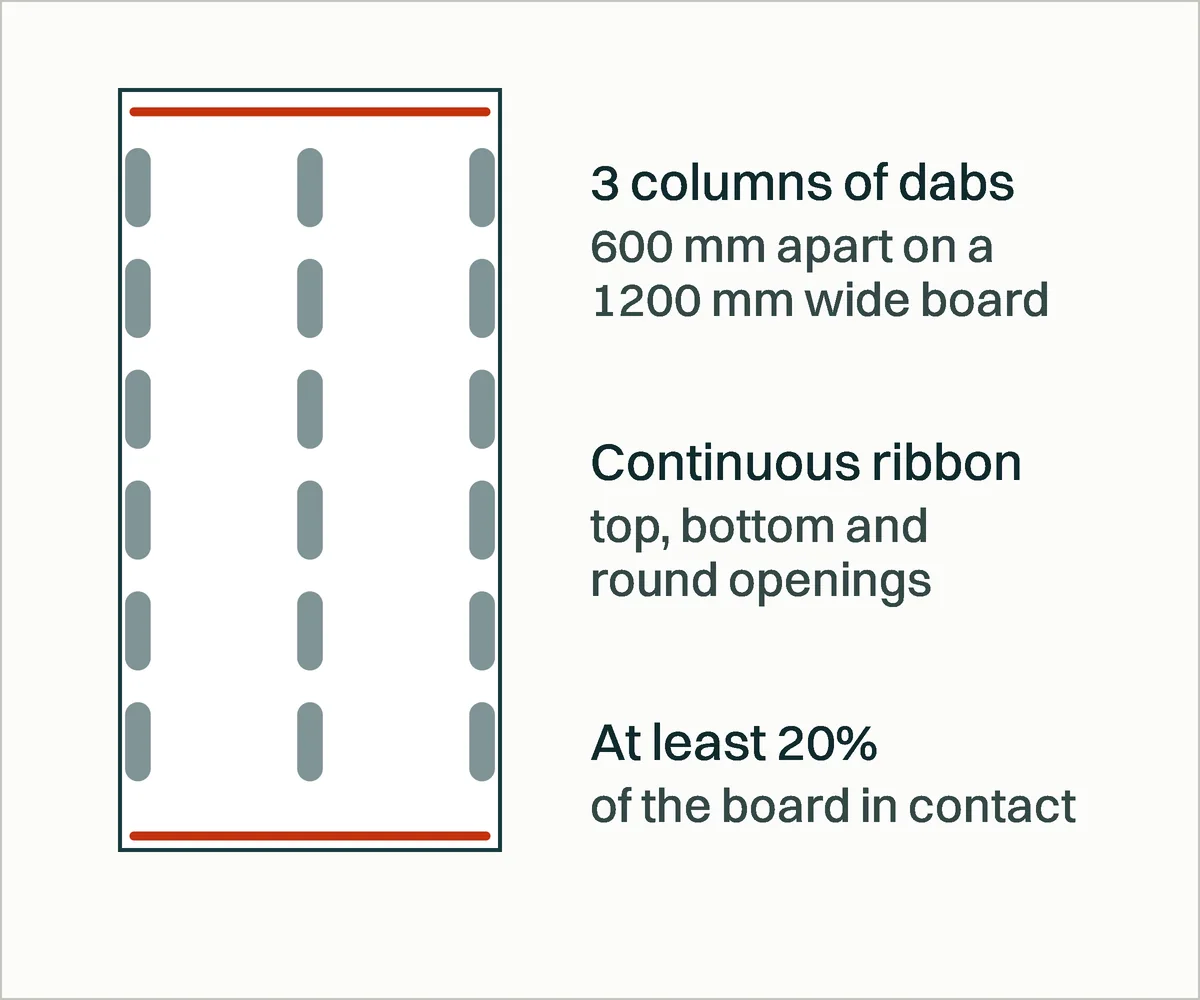
Each dab of adhesive is 50 to 75 mm wide and about 250 mm long, and once the board is pressed on it should be squashed to between 10 and 25 mm thick. The dabs go on in vertical columns about 100 mm apart, and the columns are spaced to suit the board:
| Board | Columns of dabs per board |
|---|---|
| 12.5 mm or 15 mm, 1200 mm wide | 3 columns, 600 mm apart |
| 12.5 mm or 15 mm, 900 mm wide | 3 columns, 450 mm apart |
| 9.5 mm, 1200 mm wide | 4 columns, 400 mm apart |
The adhesive in British Gypsum's system is Gyproc DriWall Adhesive, and British Gypsum asks for at least 20% of the back of the board to be in contact with adhesive, following BS 8000-8. Where two boards meet, each board gets its own column of dabs 25 mm in from the joint, so neither edge is left hanging.
The perimeter matters as much as the dabs. A continuous ribbon of adhesive runs along the base of the wall, 50 mm down from the top, and around windows, doors and every socket box. That ribbon stops air moving behind the boards, and the one at the base gives the skirting something solid to fix to. Boards are lifted tight to the ceiling with a foot lifter and held until the adhesive sets.
Pipes and conduits can run in the gap behind the board, which saves deep chasing, but they have to be fixed to the wall before the lining starts.
How much dot and dab adhesive do you need?
British Gypsum says a 25 kg bag of Gyproc DriWall Adhesive does two 1200 x 2400 mm boards in normal use, and more where the wall is out of plumb or uneven. Its data sheet gives 10 kg and 25 kg bags, 13.5 to 14.5 litres of water per 25 kg bag and up to 90 minutes of working time once mixed. The adhesive takes at least 2 hours to set, and British Gypsum's adhesive FAQs recommend leaving it 3 to 6 hours to set fully before finishing.
By that rule, a wall 4.8 m long and 2.4 m high takes four full boards and so about two 25 kg bags, with extra for a wall that is out of true. That is our arithmetic, not a British Gypsum figure.
Dot and dab or battens?
Dot and dab suits a wall that is dry, sound and reasonably flat: most internal brick and block walls, and outside walls that have no damp. It is cheaper and quicker than a frame and keeps the room as big as possible.
Timber battens or a metal furring lining are the better choice when the wall is badly out of true, when you need a deeper void for services or thicker insulation, or when the wall has a damp history. British Gypsum warns that dabbing onto damp blockwork causes trouble as the wall dries out, including stained boards. Neither lining cures damp, so the cause is found and fixed first.
On an outside solid wall that is also being insulated, the choice is about more than fixing. Internal insulation changes how the wall dries, and the government's guidance on internal wall insulation asks for the build-up to be checked for condensation risk before work starts.
Fixing heavy items to a dot and dab wall
Fix heavy items with a fixing long enough to cross the gap behind the board and go properly into the solid wall, which is British Gypsum's rule for heavier fixtures. Ordinary plasterboard plugs only grip the board, and between the dabs there is a 10 to 25 mm gap with nothing in it, so a loaded board crushes into that gap.
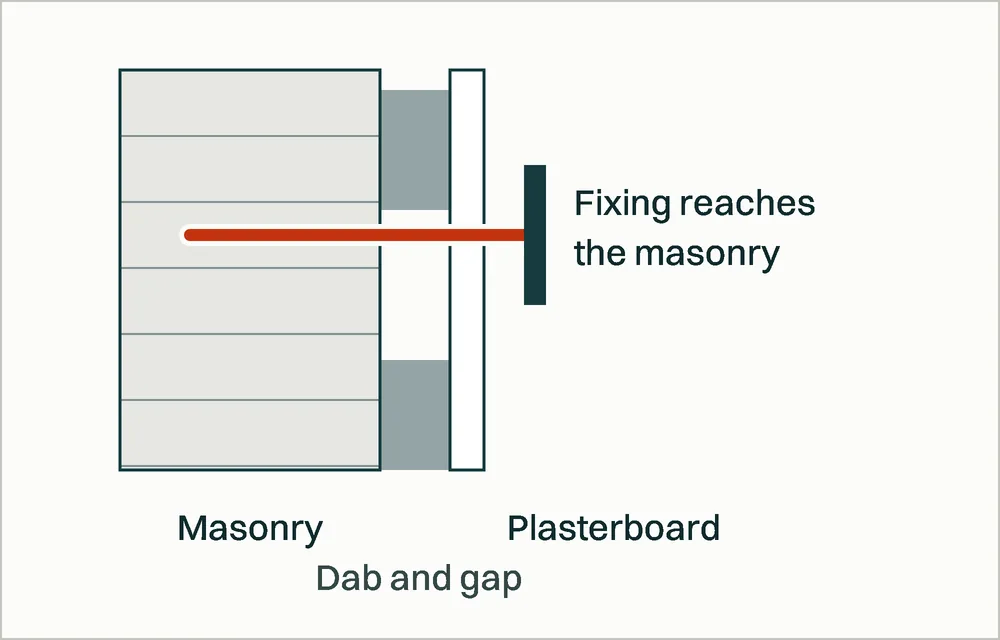
Purpose-made dot and dab fixings do exactly that. Fischer's DDF fixing has a stiff sleeve that bridges the gap and an expanding part that grips the masonry, and Fischer lists it for swivelling TV brackets, radiators, heavy shelves and kitchen wall cabinets. It is made for walls where the masonry sits no more than 45 mm behind the face of the plasterboard. Aim for the middle of a brick or block, not a mortar joint.
A kitchen run is easier to hang from a continuous rail fixed into the masonry than from screws through each cabinet back. A TV on an extending arm puts far more leverage on the top fixings than the same TV on a flat bracket, so use every fixing hole the bracket has. Before drilling, check the wall for cables and pipes. If a socket needs moving to suit the new layout, that is work for a registered electrician we arrange.
When you know where heavy things will go before the boards are on, the neater answer is timber or plywood grounds fixed to the wall at those positions, with the plasterboard dabbed around them. Our guide to pattressing covers the same idea for stud walls.
Tiling onto dot and dab
A wall that will be tiled needs an extra horizontal row of dabs at mid height, on top of the normal columns. Leave it at least seven days after boarding before tiling, so the adhesive and board have fully bonded. The weight of the tiles still has limits; our guide to how much tile weight plasterboard can take sets them out.
Dot and dab with insulated plasterboard
Insulated boards can be dabbed too, but they need mechanical fixings as well as adhesive. For Gyproc ThermaLine boards, British Gypsum specifies two of its nailable plugs per board at mid height, one each side, once the dabs have set. If those boards are being tiled, that rises to nine plugs per board in three rows of three.
Common dot and dab problems
Most faults trace back to the wall behind or the dab pattern. When we take over an old dabbed wall, the fault we find most often is too few dabs, which leaves the boards hollow. These are the usual faults and their causes:
| What you see | Usual cause and the fix |
|---|---|
| Hollow or drummy boards | Too few dabs or poor contact. Keep to the column spacing and the 20% contact minimum. |
| Board pulling away from the adhesive | A dusty wall with no key. Brush the wall down; British Gypsum recommends Thistle GypPrime on very absorbent dry walls. |
| Stains coming through | Dabbing onto damp blockwork. Let the wall dry, or fix the damp first. |
| Draughts and cold spots | No continuous ribbon at the edges, openings and socket boxes, so air moves behind the board. |
| Cracks along board joints | Joints with no dabs behind them. Give each board its own column 25 mm in from the joint. |
On walls between flats or houses, and on outside walls where airtightness and sound matter, British Gypsum's system adds a continuous 6 mm coat of Gyproc SoundCoat Plus to the masonry before the boards are dabbed on. If neighbours' noise is the worry, ask for that coat by name.
Can you dot and dab a ceiling?
No. British Gypsum's dab lining is designed for walls, and ceilings are boarded onto a fixed frame, usually a metal furring ceiling, which our guide to MF ceilings and bulkheads explains.
Getting a wall lined
For a lining job, our engineer visits free and with no obligation to order. They look at the wall for damp and flatness, ask what will hang on it and where the sockets go, and then we put the method in writing: dot and dab, battens or a metal lining, with the board, the finish and the fixing positions listed. You can see the kind of drylining we do on our drylining and ceilings page, or send us the room and its measurements and we'll tell you which method suits it.